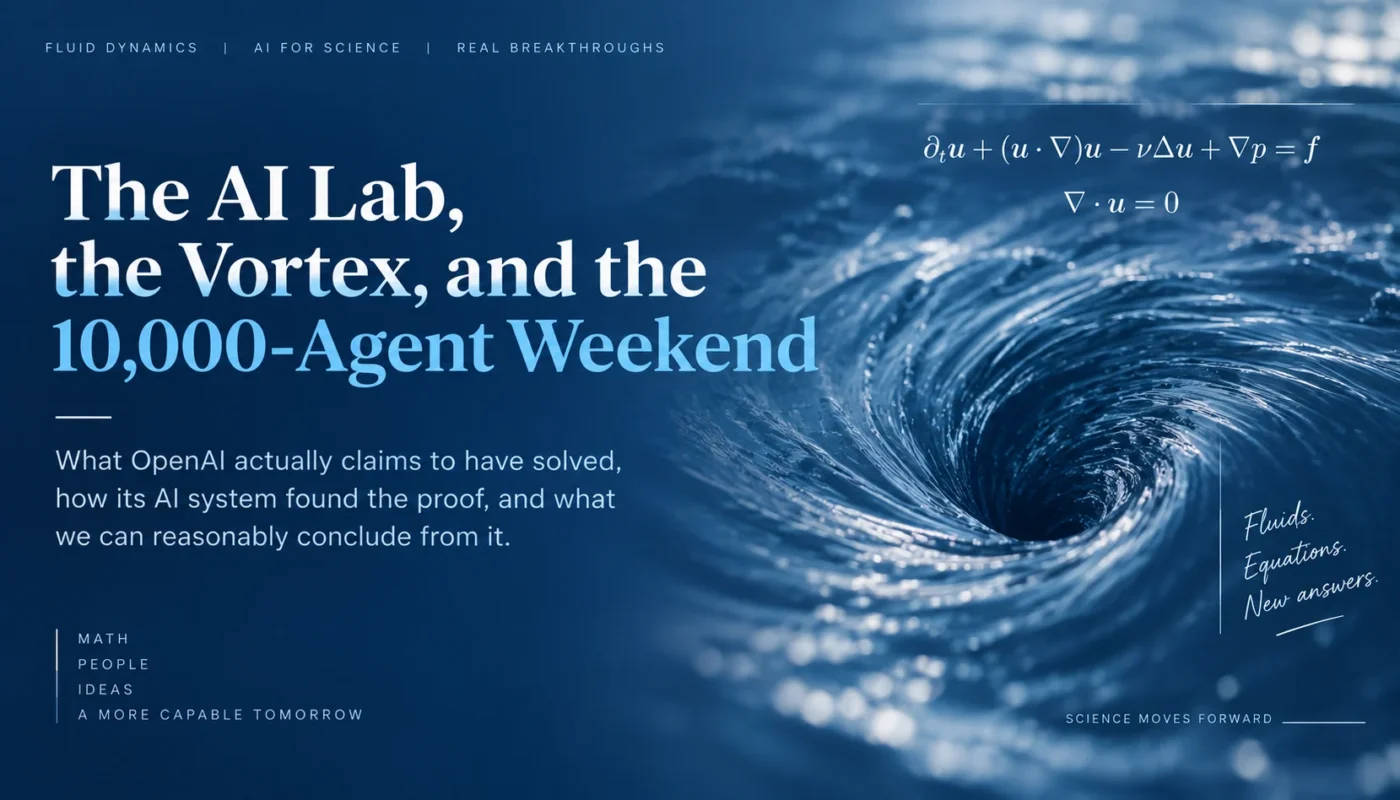
What OpenAI actually claims to have solved, how its AI system found the proof, and what we can reasonably conclude from it.
The story starts with a question about fluid motion. The 10,000 agents and the dispute over scientific credit come later.
The Navier–Stokes equations describe how fluids move. They appear in models of air around aircraft, water inside pipes, blood flowing through arteries, and weather systems developing across the atmosphere. For an incompressible fluid, the equations can be written as
Here u(x, t) is the velocity of the fluid at position x and time t, p is pressure, ν is viscosity, and f represents an external force. The second equation says that the fluid is incompressible. It can move and rearrange itself, but it cannot simply accumulate inside a region without flowing somewhere else.
The main difficulty sits inside the first equation. The nonlinear term (u·∇)u describes the fluid carrying and distorting its own velocity. A vortex can stretch another vortex, transferring motion into increasingly small regions. The viscosity term νΔu pushes in the opposite direction. It spreads sharp velocity differences out and tries to keep the flow smooth.
The open problem is therefore a competition between concentration and dissipation. If we begin with a perfectly smooth three-dimensional flow, does viscosity guarantee that it remains smooth forever? Or can nonlinear motion concentrate velocity so strongly that the mathematical solution becomes singular after a finite amount of time?
Such a singularity, usually called blowup, does not mean that the fluid explodes. It means that a quantity required for the smooth solution becomes unbounded. In the result claimed by OpenAI, the maximum velocity satisfies
As the time approaches t = 1, the velocity becomes arbitrarily large somewhere in the fluid. A classical smooth solution cannot then continue through that time.
The official Clay Mathematics Institute formulation gives mathematicians four acceptable routes to settling the problem. Options A and B ask for a proof that smooth solutions exist forever without any external force, either across ordinary three-dimensional space or in a periodic domain. Options C and D ask for a counterexample: smooth initial data and a smooth external force for which no global smooth solution with bounded energy can exist.
OpenAI claims to have proved C and D. It has not shown that an ordinary unforced fluid will spontaneously form a singularity. This makes the result narrower than the version usually described in popular explanations, but it is still a direct answer to the official Millennium Problem. Smooth forced blowup was included as an acceptable resolution from the beginning.
According to OpenAI’s 165-page analytical paper, the constructed fluid begins completely at rest,
A smooth force, compactly supported in both space and time, then creates a rotating flow. Fluid moves radially inward while carrying angular momentum toward the central axis. Since angular momentum is approximately proportional to ruθ, reducing the radius r increases the circulating speed uθ. The basic intuition is similar to a skater rotating faster after pulling their arms inward.
The fluid is incompressible, so it cannot simply collect around the axis. It escapes along the vertical direction, producing a vortex with inward spiralling and axial outflow. Pressure supplies the centripetal acceleration, while viscosity continues to transport angular momentum outward and resist the concentration.
As the proposed singular time approaches, the active region becomes narrower and more elongated while its velocity grows. The striking part is that the total kinetic energy remains bounded:
There is no contradiction between bounded energy and unbounded maximum speed. The maximum norm measures the fastest point in the fluid, whereas the L2 norm adds velocity across the entire volume. The high-speed region shrinks rapidly enough that the total energy contained inside it remains finite. A spike can become infinitely tall while narrowing quickly enough for the area underneath it to stay bounded.
The hardest part is not creating a fast vortex. If we chose any desired velocity field u, we could define the required force by rearranging the equation:
The flow would then satisfy Navier–Stokes by construction. The problem is that if u becomes singular, the resulting f will usually become singular as well. Clay requires the external force to remain smooth, so the singularity cannot simply be inserted through the forcing term.
OpenAI’s construction addresses this using families of spatially oscillatory pulses placed around the main vortex. Each pulse begins extremely small and is amplified by the shear of the background flow. Through nonlinear advection, the pulse creates an internal momentum flux that cancels the dangerous residual produced by the collapsing vortex. Viscosity eventually damps that pulse, while new pulses operate at smaller spatial and temporal scales.
The external force only seeds the pulses. The fluid’s own dynamics amplify them and generate the momentum transport needed to preserve the construction. The terms representing acceleration, pressure, nonlinear transport, and viscosity may individually become large, but their leading singular parts cancel. What remains is a force that extends smoothly through the blowup time.
The result therefore does not say that normal water will suddenly reach infinite velocity. Real fluids are made of molecules and eventually stop behaving like infinitely divisible continua. The proposed singularity shows that the continuum equation can break down under a highly engineered but mathematically admissible forcing regime. It is a result about the limits of the model, not a prediction of an everyday fluid disaster.
That is the physics. The method by which the proof was found is a different kind of result.
In its official announcement, OpenAI says it began training a new internal model on August 28. The company describes this model as significantly more capable than GPT-6 Astra and says that its performance continued to improve during the project.
On September 1, OpenAI heard rumors that two Millennium Prize Problems may have been solved. It responded by launching an internal evaluation across the remaining problems and several related questions. Instead of assigning one model to one theorem, OpenAI divided the work among groups of agents. Different groups received different formulations of the same problem, including all four Navier–Stokes options, while other groups were assigned easier neighbouring problems that might reveal useful techniques.
The agents had access to tools. They could run code, consult a cached copy of the internet, and communicate within their groups. OpenAI encouraged different groups to explore different strategies instead of forcing them toward a single proof plan. Useful intermediate results were later consolidated using Codex and redistributed between groups. When a more recently trained version of the internal model became available, the agents were updated during the project.
One of the easier targets was the regularity problem for the Euler equations, which describe fluid motion without viscosity. OpenAI says nearly 100 agents worked together for approximately 50 hours and produced a claimed unforced Euler blowup result. This result made Navier–Stokes appear more promising, so the company moved agents and compute away from other problems and concentrated them there.
The successful Navier–Stokes effort involved roughly 10,000 concurrent agents.
OpenAI says the agents reached the Navier–Stokes result after approximately 88 hours. During that effort, they exchanged 2.7 million messages and generated around 130 billion output tokens. Across all the mathematical problems attempted, the total reached 4.9 million messages and approximately 300 billion output tokens.
The analytical proof was then passed to GPT-6 Astra, which reportedly required another 17 hours to translate and verify it in Lean. The formal proof is publicly available.
Lean matters because it does not evaluate a proof by deciding whether its language sounds persuasive. Every definition, assumption, and logical step must be encoded explicitly and checked by a small proof kernel. This removes many of the ordinary failure modes associated with long AI-generated arguments. A model cannot hide an unsupported step behind confident prose if the formal system demands a valid derivation.
Formal verification is not the same as complete external acceptance. Mathematicians still need to confirm that the Lean statement faithfully captures Clay’s original analytical conditions, including smoothness, bounded energy, compact support, and the absence of a global solution. But the public formalization makes the proposal substantially more credible than an ordinary machine-generated preprint.
The larger AI lesson is that this was not one autonomous model behaving like a solitary mathematician. It was an organized search process. Humans selected the problems, divided them into variants, supplied the agents with tools, redirected resources after the Euler result, decided when to consolidate ideas, and chose which output deserved formalization. The models supplied breadth, speed, mathematical reasoning, criticism, and the ability to explore thousands of branches in parallel.
The setup resembled a temporary research team assembled from model copies. Thousands of agents explored ideas, while a coordinating process shared promising results between them. The gain came from organising the search as well as solving individual steps.
This is consistent with OpenAI’s broader report on agent-assisted research. By mid-August, the company says its median researcher was using more than $600 per day of agent inference at API prices, while researchers at the 90th percentile were using more than $7,000 per day. OpenAI also estimates that its research organization was consuming 3.1 agent-workdays for every human workday.
Navier–Stokes was therefore not an isolated prompt demonstration. It was an unusually visible result produced by an internal research system that OpenAI had already been scaling across its organization.
The controversy surrounding the result concerns where that search process began and how its intellectual history should be recorded.
The broad construction did not originate during OpenAI’s 88-hour run. Diego Córdoba and Luis Martínez-Zoroa had spent several years developing analytic approaches to forced blowup using increasingly concentrated vortex layers. Their work established the idea that larger-scale strain could amplify smaller-scale structures while careful corrections controlled the regularity of the external force.
NYU mathematician Tristan Buckmaster and Levent Alpöge, an Anthropic employee collaborating in a personal capacity, spent much of the following year extending this program. According to Buckmaster’s statement, they used several language models, including Claude and OpenAI’s Codex. On August 15, they obtained smooth-forcing blowup results for the Euler and Boussinesq equations. The Euler result was verified in Lean on August 22.
They had not solved the standard Navier–Stokes problem. Their importance to the story is that they were pursuing the same relatively uncommon smooth-forcing route and had used Codex while developing unpublished arguments.
OpenAI says that rumors about their progress reached the company on September 1 and inspired its broader Millennium evaluation. Buckmaster contacted a mathematician at OpenAI on September 3 after hearing that information about his collaboration was circulating. He said that he and Alpöge had important related results and intended to publish, but he did not provide their proof.
OpenAI reports completing its Navier–Stokes argument on September 5 and its Lean verification on September 6. Buckmaster and Alpöge released their related results on September 7. OpenAI announced its Navier–Stokes result the following morning.
Buckmaster regarded OpenAI’s arrival at options C and D as suspicious because the smooth-forcing direction was closely associated with the Córdoba and Martínez-Zoroa program that his group had been extending. He also asked whether the internal OpenAI model had accessed or learned from the Codex sessions containing their drafts.
OpenAI says neither its researchers nor agents saw the unpublished work and that no specific user data was accessed to solve the problem. It nevertheless says it cannot completely rule out de-identified data derived from product usage having contributed to general model improvements, although it considers this unlikely.
There is no public evidence that OpenAI retrieved or deliberately used the private drafts. Buckmaster says he does not know whether their data was used and has not accused OpenAI of stealing the proof. The provenance question remains: the company supplied their research tool, owned a stronger private model and could direct thousands of agents toward the same problem.
A further disagreement concerned the proposed presentation of the results. Buckmaster says OpenAI suggested that he lead a rewrite explaining its Navier–Stokes proof without Alpöge, whose employment at Anthropic complicated the arrangement. Sébastien Bubeck later clarified that he had not proposed removing Alpöge from the pair’s own Euler paper. He was referring to a separate paper based on OpenAI’s result and believed that an Anthropic employee should not author work produced by an internal OpenAI model. Bubeck also apologized for language he used during the conversation.
The competing accounts do not change the mathematical content of OpenAI’s proof. They do show that existing conventions for priority and authorship are poorly prepared for AI-assisted research. One group may open a method, another may extend it through neighbouring problems, and a private multi-agent system may then use massive parallel search to complete the final step. Traditional authorship rules do not cleanly describe that chain.
Clay continues to list Navier–Stokes as unsolved. Its rules require publication in a qualifying outlet, at least two years of scrutiny, and general acceptance by the global mathematics community before a proposed solution can be formally considered. OpenAI has also said that it does not intend to claim the $1 million prize.
For now, this is a formally checked proposed resolution of the official forced formulation. The analytical manuscript and public formalization arrived less than a week after the rumor that prompted the search. Experts can now examine whether the result meets Clay’s conditions.
The mathematics now has a clear verification process. Experts can inspect the theorem, rebuild the Lean project, compare its assumptions with the Clay statement, and examine every part of the construction.
The more difficult question is what happens around that proof. If researchers use commercial models to develop unpublished ideas, while the companies operating those models possess far stronger internal systems, then data policy, model provenance, and research priority become part of scientific method. Lean can verify the conclusion of an argument. It cannot determine where an idea first entered the system or how credit should travel through thousands of agents.
If the proof survives review, it resolves an accepted version of the mathematical problem. The research process raises a separate question: how should scientists record priority and credit when private agent systems can extend unpublished lines of work at this scale?
For a complementary view of how to make AI evaluation claims auditable, see Perit’s benchmark methodology, including how human references and adjudication are handled.
Primary Sources
- OpenAI: On the Navier–Stokes Millennium Prize Problem
- OpenAI: Finite Time Blowup for Navier–Stokes
- OpenAI: Public Lean formalization
- Clay Mathematics Institute: Official Navier–Stokes problem statement
- OpenAI: Research acceleration inside OpenAI
- Tristan Buckmaster: Statement on the concurrent work and dispute
- Sébastien Bubeck: Public clarification
- Quanta Magazine: Independent reporting and mathematical context
- Clay Mathematics Institute: Millennium Prize rules