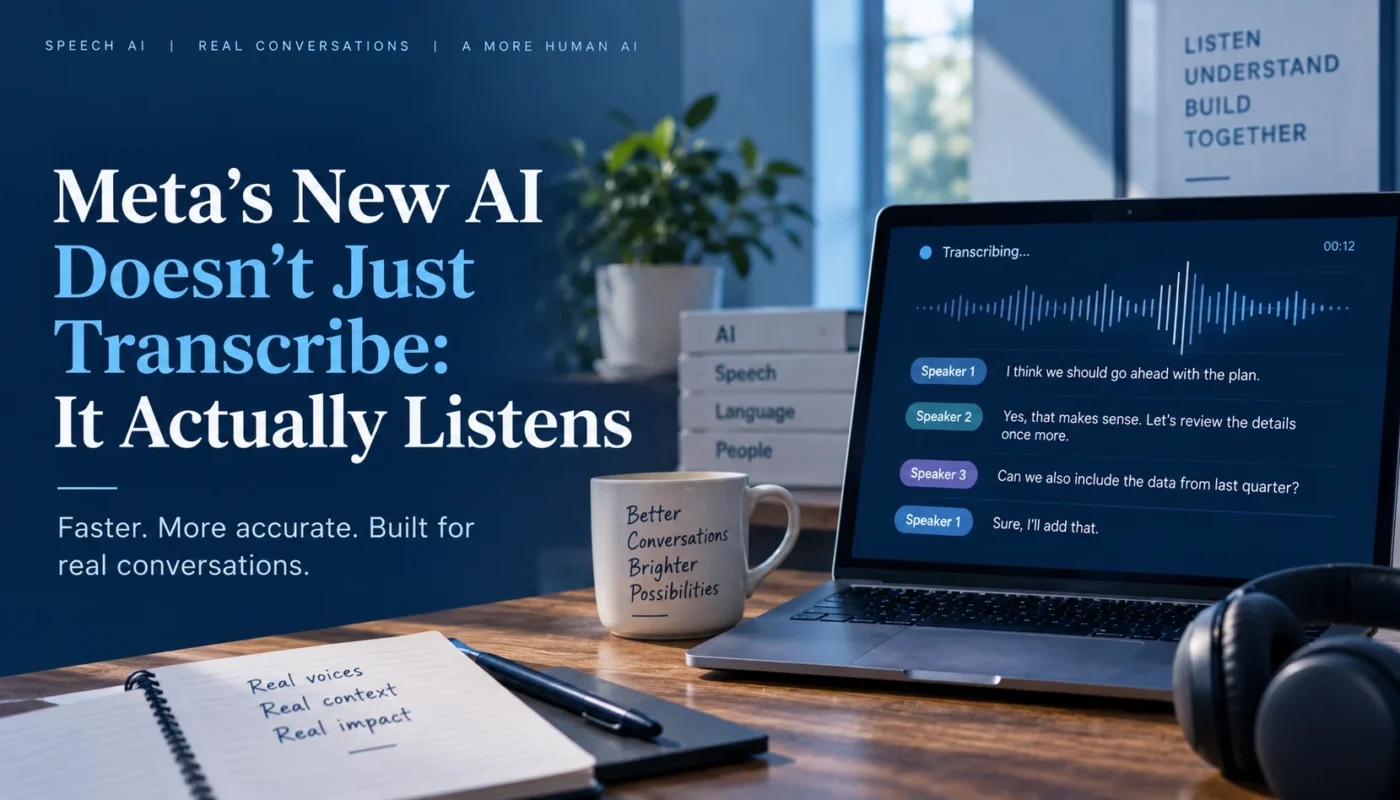
There’s a moment in almost every recorded conversation where the transcript falls apart,
someone talks over someone else, a technical term gets butchered, or the software just can’t keep
up with how fast people actually talk. Meta Superintelligence Labs seems to have taken that
frustration personally. On September 1, 2026, they released Muse Voice Transcribe [1], and it’s
less “another transcription tool” and more an attempt to fix the whole category at once.
Real-time transcription has always demanded a trade-off. Fast systems tend to get sloppy.
Accurate systems tend to lag behind and almost none of them can reliably tell you who said what
the moment more than two people are in the room. Muse Voice Transcribe tries to do all three
jobs: transcription, speaker identification, and knowing when someone’s actually finished
talking, inside a single model [2]. Instead of stitching together three separate systems the way
most tools do, Meta’s approach folds them into one, which cuts down on lag and lets the pieces
reinforce each other instead of tripping over one another.
So how does it actually manage speed and accuracy at once?
Here’s the part worth actually understanding: Meta claims Muse sits near the Pareto frontier on
the speed-accuracy trade-off [1]. It describes the most efficient point possible between two
competing goals, where improving one thing necessarily means sacrificing the other. Most
transcription models live inside that frontier, leaving performance on the table. Muse claims to
sit right on the edge of it.
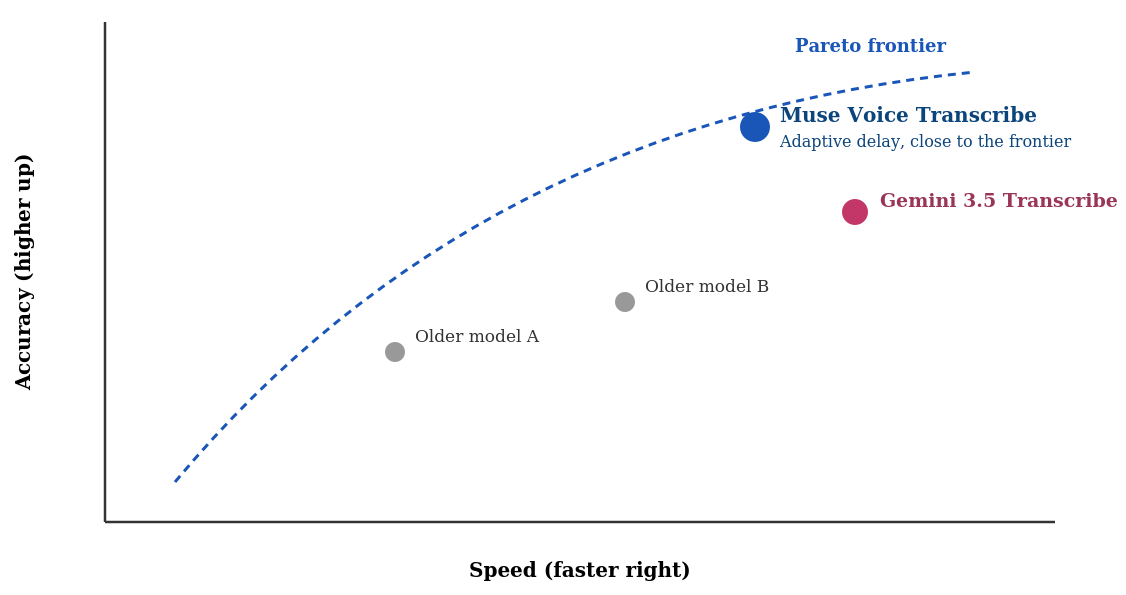
The speed accuracy trade-off: Muse near the Pareto Frontier
The speed accuracy trade-off: Muse near the Pareto Frontier
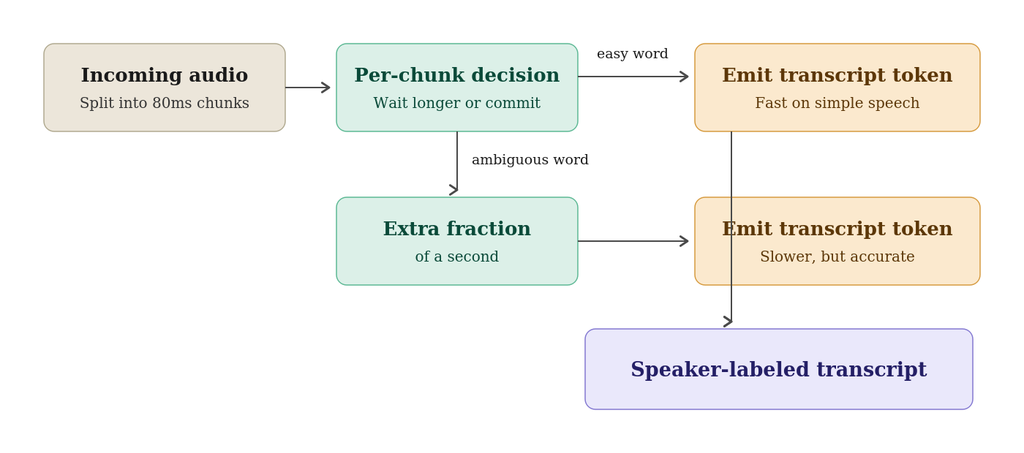
It processes audio in 80-millisecond chunks and makes a call after each one: commit to a word,
or wait a beat longer [3]. Easy words fly through. Ambiguous ones get an extra fraction of a
second, which is more or less what a good human listener does too.
Handling real conversations
Real speech is messy, and this model seems built with that in mind. It’s trained across more than
70 languages, with 25 validated at launch [4], and it can follow code-switching, thus handling it
smoothly when speakers change languages mid-conversation. It’s also stress-tested for genuinely
chaotic conditions, hour-long sessions with 20+ distinct speakers talking over each other, not a
polished two-person podcast clip [2].
The game changer
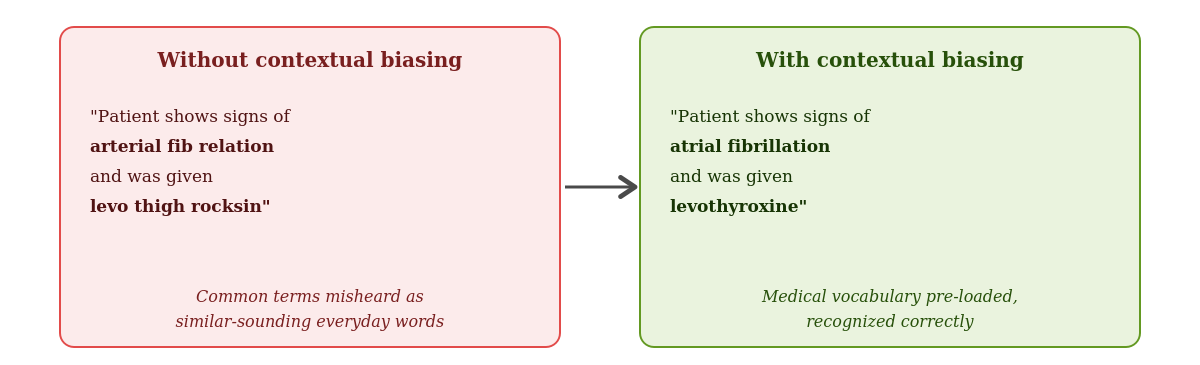
The one feature that actually separates this from a generic transcription tool: contextual biasing
[2]. Before a session starts, you feed the model a list of names or terms it’s likely to hear. It then
leans toward recognizing those specific words when the audio gets ambiguous.
It’s important because general-purpose speech models are trained on everyday language, which
doesn’t include heavy medical or technical terms or a client’s oddly-spelled surname. Feed the
model that vocabulary ahead of time, medical terms, technical terminology, legal jargon, internal
codenames, and it stops guessing and starts recognizing.
It’s a quiet signal of who this is really built for: not everyday users, but hospitals, law firms, and
enterprise teams drowning in specialized vocabulary.
Illustrative example based on Contextual Biasing
Watch it in action
It’s one thing to read that a model can separate eight overlapping voices in real time. It’s another
to actually listen to it happen. Meta posted a demo showing exactly that, eight people in one
room, talking over each other, switching into Mandarin mid-sentence, and the model keeping
every voice straight without missing a beat [2].
Video: AI at Meta (@AIatMeta), demo of Muse Voice Transcribe separating eight simultaneous
speakers, posted on X, September 1, 2026 [2]. Video credit: X / @AIatMeta.
What’s worth noticing here isn’t just that it works, it’s how unremarkable the moment feels while
it’s happening. Nobody pauses for the model to catch up. Nobody repeats themselves. The
transcript just keeps pace, which is a quieter kind of proof than any benchmark number could
offer.
Pricing and access
Muse Voice Transcribe is live now through the Meta AI Mac app, and developers can plug into it
via Muse Code and Meta’s Model API [5]. Pricing works out to roughly $0.18 per hour of audio
[6], reportedly around 80% cheaper than Google Cloud’s standard transcription pricing. That’s
not a rounding-error discount. That’s the kind of gap that could reshape how developers budget
for voice features at scale.
The competition
Timing-wise, this drops right on the heels of Google’s Gemini 3.5 Transcribe [7], which also
does streaming transcription, diarization, and custom vocabulary handling, plus some
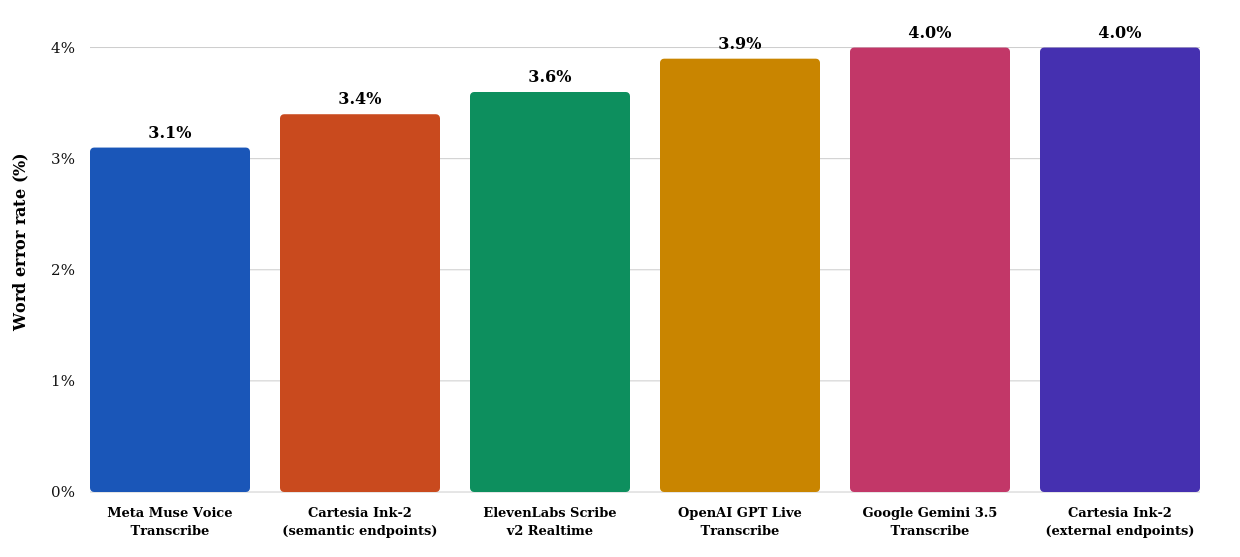
consumer-friendly extras like cleaning up filler words automatically. On independent tests by
Artificial Analysis, Muse beats Gemini on raw accuracy: 3.1% error rate versus Gemini’s 4.0%
[1] [8].
Streaming word error rate across leading transcription models
Muse doesn’t just beat Gemini, it beats the whole field. Gemini’s real pitch isn’t accuracy
anyway, it’s convenience: broader language detection and cleaner-sounding transcripts.
This convergence suggests something larger than coincidence: it signals a clear shift in where the
industry is headed.
References
[1] Meta AI Research, “Introducing Muse Voice Transcribe,” 2026.
https://research.meta.ai/blog/introducing-muse-voice-transcribe
[2] AI at Meta (@AIatMeta), X post, September 1, 2026.
https://x.com/AIatMeta/status/2094839236016976028
[3] Fonearena, “Meta introduces Muse Voice Transcribe with real-time ASR, 70+ languages and 20+ speakers,” 2026.
https://www.fonearena.com/blog/491194/meta-muse-voice-transcribe-features.html
[4] 9 to 5 Mac, “Meta launches Muse Voice Transcribe for real-time voice dictation on Mac,” 2026.
Meta launches Muse Voice Transcribe for real-time voice dictation on Mac – 9to5Mac
[5] iTechPost, “Meta’s Muse Voice Transcribe With Real-Time Voice Dictation Arrives on Mac,” 2026.
Meta’s Muse Voice Transcribe With Real-Time Voice Dictation Arrives on Mac
[6] DataNorth AI, “Meta Muse Voice Transcribe: price and features,” 2026.
https://datanorth.ai/news/meta-launches-muse-voice-transcribe
[7] Google, “Introducing Gemini 3.5 Transcribe,” 2026.
Introducing Gemini 3.5 Transcribe
[8] 9to5Google, “Google launches Gemini 3.5 Transcribe, which powers Gboard Rambler and is coming to Chrome,” 2026.
https://9to5google.com/2026/08/26/gemini-3-5-transcribe/