Imagine you have a report to finish before tomorrow morning. You need to research several websites, compare the findings, update a spreadsheet, and turn everything into a polished document. You ask an AI assistant for help. It gives you a useful starting point, but you still have to gather the information, check the figures, organize the files, and complete the remaining work yourself.
Now imagine handing over the entire task. You explain what you need, provide access to the relevant files, and set a few boundaries. The AI researches the topic, organizes its findings, prepares the spreadsheet, and drafts the report while you focus on something else. When you return, you can review what it has accomplished.
This is the promise of persistent AI agents. Instead of simply responding to prompts, these systems aim to manage longer tasks, use software, retain progress, and continue working beyond a single conversation. Products such as Claude Cowork, Grok Bot, and OpenAI dots reflect this shift, raising an important question: what does it take for AI to work on our behalf rather than simply answer our questions?
Traditional chatbots respond to individual prompts. Persistent AI agents can carry work across multiple steps, use tools, retain relevant task state, and continue toward a defined goal. Their real value lies not simply in generating answers, but in completing useful work with appropriate permissions and verification.
From Chatting to Completing Work
Traditional AI assistants are useful for answering questions, generating ideas, writing code, and summarizing documents. However, the user usually remains responsible for connecting individual actions. An assistant might explain how to conduct a competitor analysis, but someone still needs to research companies, organize the evidence, update the spreadsheet, and prepare the final report.
An AI agent can potentially manage more of that process. It can break the goal into smaller steps, use available tools to perform them, inspect the results, and determine what needs to happen next. If a website fails to load, it might try another source. If information is incomplete, it may search again rather than immediately stopping.
Persistence takes this a step further. Depending on the system, an agent may retain task progress, resume work after an interruption, or continue operating in the background. Some systems can also initiate tasks based on schedules or events. These capabilities are not identical: an assistant that remembers preferences is not necessarily autonomous, and an agent that runs for several minutes may not be able to resume work the next day.
The real change is that users can delegate more of the coordination. Instead of directing every individual action, they can define the desired outcome, establish boundaries, and review the finished work.
How Does a Persistent Agent Work?
A language model can interpret instructions and suggest actions, but completing a longer task requires additional components. A practical agent combines a model with a planning mechanism, tools, task-state storage, and an environment in which its actions can run. [4]
The model interprets the user’s goal and helps decide what to do. A controller coordinates the workflow, while tools provide access to browsers, files, code execution, and connected applications. A task-state mechanism records completed steps and unresolved work, and an execution environment supplies the resources needed to continue operating.
Consider an agent asked to research a new technology and prepare a report. It might gather sources, extract important claims, compare the evidence, and draft the document. If a source is unavailable or two sources disagree, it needs to adapt instead of blindly continuing with its original plan.
This process is often represented as an agent loop:
Figure 1. The persistent agent workflow.
The important part is the feedback. A model may plan to save a file, but the operation could fail. A system that assumes every planned action succeeded can produce incomplete work while claiming that the task is finished. A dependable agent needs to inspect outcomes, track progress, and recover from errors.
Memory also matters, but not all memory serves the same purpose. An agent may retain task progress, information from previous conversations, or user preferences. Remembering that someone prefers concise reports is different from remembering which sources have already been checked for a particular project. Persistent systems need to preserve useful context without treating every stored assumption as unquestionably correct.
Why the Cloud Matters
For an agent to keep working while a user is away, it needs an environment in which its tasks can continue running. If the agent depends entirely on a program running on a laptop, closing that program or switching off the computer may interrupt its work. A cloud-based execution environment can allow the task to continue on remote computing resources.
However, a cloud-hosted model is not automatically a cloud-hosted agent. A model service processes requests and returns responses, whereas an agent also needs infrastructure to coordinate actions, preserve task state, manage files, and interact with applications. This may involve a remote computer, browser, container, database, or connected services.
Access is another important distinction. An agent cannot automatically control every application just because its model runs online. It needs an authorized connection, such as an API, an integration, a browser, or a computer-use interface. Accessing files on a personal computer may require a separate desktop connection.
Cloud execution makes persistent work more practical, but it does not guarantee accuracy. Websites change, logins expire, and applications fail. A reliable system must preserve progress, handle interruptions, and avoid repeating actions that may already have succeeded. The cloud gives an agent somewhere to work; the surrounding software determines how reliably it works.
Figure 2. Inside a cloud-based AI agent.
Three Products Exploring the Shift
Claude Cowork, Grok Bot, and OpenAI dots illustrate different approaches to persistent AI. Their advertised capabilities, access conditions, and integrations differ, so they should not be treated as interchangeable.
Claude Cowork: Bringing AI Into Desktop Work
Anthropic introduced Claude Cowork as a research preview in January 2026. It extends ideas from Claude Code into a more accessible experience for people who want AI assistance with practical computer-based tasks, particularly those involving files and desktop-oriented work. [1]
A January 2026 WIRED hands-on review discussed tasks involving file organization, file conversion, report creation, and browser-based work. The review also raised concerns about limitations and the risks of giving an agent access to sensitive information. This illustrates why successful demonstrations should not be mistaken for proof of general reliability. An agent must not only perform the requested action but also preserve the right files and handle unexpected situations safely. [5]
Cowork’s broader significance is its attempt to make task delegation accessible through a familiar interface. Its usefulness still depends on the available features, permissions, and complexity of the task.
Grok Bot: An AI Teammate That Keeps Working
xAI’s Grok Bot announcement describes persistent agents with their own computers that can work across applications and continue tasks in the background. The company also describes multiple bots working in parallel, allowing different responsibilities to be handled by different agents. [2]
Imagine a sales workflow involving customer research, record updates, and preparation of follow-up messages. A persistent agent could potentially coordinate these actions rather than requiring the user to manage every transition. The benefit is not just completing individual steps, but reducing the effort needed to connect them.
However, calling an agent a teammate does not mean it can safely handle every responsibility. Its usefulness depends on its application access, ability to recover from errors, and safeguards around consequential actions. Independent testing is needed to determine how consistently advertised capabilities translate into successful outcomes.
OpenAI dots: Maintaining Continuity Across Tasks
OpenAI’s announcement of dots describes always-on agents with cloud computers, connections to supported applications, and the ability to incorporate user feedback. The idea is to let users return to ongoing work without repeatedly explaining the same project or starting from scratch. [3]
A cloud computer gives an agent an environment that can remain available independently of the user’s personal device. Connecting an agent to a user’s own computer is a separate matter, however, and introduces different permissions and security considerations. Users need to understand where their files are processed, which applications are accessible, and what the agent can change without approval.
All three products point toward a similar direction: AI systems that can retain context, interact with software, and continue work beyond a single exchange. The meaningful comparison is not which product sounds the most autonomous, but which can reliably complete a defined task while respecting the user’s boundaries.
| Dimension | Claude Cowork | Grok Bot | OpenAI dots |
|---|---|---|---|
| Primary focus | Knowledge work and task execution | Agentic assistance within its supported environment | Personal assistance and ongoing tasks |
| Interaction model | Delegate work and review outputs | Issue requests and direct supported actions | Delegate tasks and maintain ongoing context |
| What to evaluate | Workflow fit, file access, and execution controls | Supported tools, task boundaries, and reliability | Continuity, permissions, and available integrations |
| Key consideration | Verify which operations require user approval | Confirm which actions and environments are supported | Check availability and the actual persistence model |
Table 1. Comparing three approaches to persistent AI.
The Hard Part Is Trustworthy Execution
Giving an AI more tools and time can make it more useful, but it can also make mistakes more consequential. A chatbot might produce an incorrect answer; an agent with access to files or email could overwrite a document, send an inaccurate message, or repeat a mistake across several steps.
Consider a workflow with ten necessary steps, each having a 95% chance of succeeding. If the steps were independent and every step had to succeed, the probability of completing all ten without a failure would be:
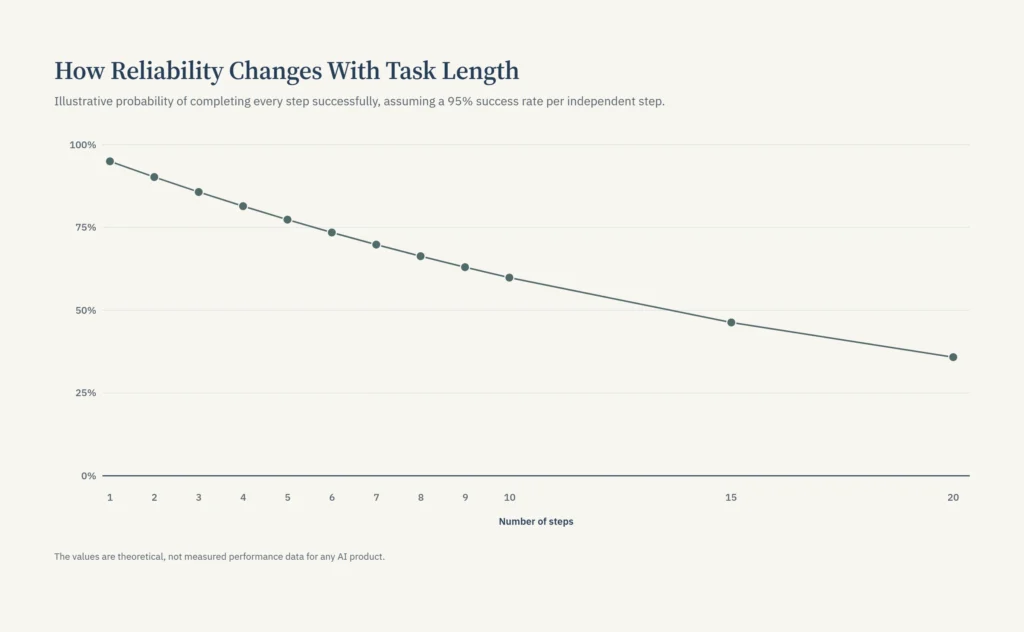
This is a simplified illustration, not a measured success rate for any particular product. Real failures are not always independent, and agents may detect and correct errors. Nevertheless, it demonstrates why reliability must be evaluated across the entire workflow rather than through individual actions alone.
Security presents another challenge. A webpage, email, or document may contain instructions designed to manipulate an agent into ignoring its original task or misusing its tools. This is commonly associated with prompt injection. If an agent has access to private information or can change other applications, such manipulation can have consequences beyond an incorrect response. [6]
Permissions and verification are therefore essential. An agent preparing a draft may need to read documents and create a file, but it does not necessarily need permission to send emails or delete source material. Consequential actions may require human approval, while completed work should be checked against clear criteria. A report can be verified against its sources, spreadsheet calculations can be tested, and file changes can be confirmed by inspecting the results.
This is a conceptual model, not an empirically measured equation. It highlights how weaknesses in task definition, permissions, continuity, or result checking can undermine an otherwise capable agent.
These safeguards are not obstacles to autonomy. They are part of what makes it possible to delegate work without surrendering control.
What Comes Next?
Persistent agents could change how people approach everyday computer work. Instead of opening each application and manually coordinating every step, users may increasingly describe the outcome they want and supervise the process. Research, reporting, software maintenance, and administrative workflows are potential applications, especially when tasks involve several tools or repeated follow-ups.
Progress should be measured by more than how long an agent can run unattended or how many integrations it supports. More meaningful measures include the correctness of the final result, the amount of human intervention required, the ability to recover from interruptions, and whether the agent respects its permissions. Comparisons are most useful when products are tested on similar tasks under comparable conditions.
Persistent AI agents are not simply chatbots that never go to sleep. They combine models with planning, memory, tools, execution environments, and safeguards to manage work over time. Products such as Claude Cowork, Grok Bot, and OpenAI dots show how this idea is being translated into practical experiences, but their long-term value depends on whether they can move beyond impressive demonstrations and become dependable systems.
The goal is not to have AI running continuously for its own sake. It is to spend less time coordinating routine steps and more time making decisions that genuinely require human judgment. The real promise of persistent AI agents is being able to hand off a well-defined goal, trust the system to work within clear boundaries, and return to work that is genuinely finished—not just another answer waiting for your next instruction.
References
- Anthropic. (2026).
Introducing Labs.
Official announcement, January 13, 2026. - xAI. (2026).
Introducing Grok Bot.
Official announcement, August 11, 2026. - OpenAI. (2026).
Introducing dots.
Official announcement, September 29, 2026. - Xu, B. (2026).
AI Agent Systems: Architectures, Applications, and Evaluation.
arXiv preprint, arXiv:2601.01743. - Rogers, R. (2026).
Anthropic’s Claude Cowork Is an AI Agent That Actually Works.
WIRED, January 15, 2026. - Ma, W., Han, Q.-L., Zhu, X., Zhou, W., Xiong, J., Ren, Z., Wen, S., & Xiang, Y. (2026).
OpenClaw in the Wild: Security Analysis of Autonomous Agents.
IEEE/CAA Journal of Automatica Sinica, 13(6), 1257–1273.