Why AI-Ready Data Requires More Than Annotation
Building an AI model does not start with choosing a model architecture. It starts with getting the right data. Images, videos, audio recordings, documents, conversations, and sensor data may contain the information a model needs, but raw data is rarely ready to go straight into training.
Before that can happen, the data often needs to be collected, cleaned, organized, and annotated. A speech dataset may need accurate transcripts and speaker information. An image dataset might require bounding boxes, masks, or object attributes. Video can require labels that show what happened and when, while documents may need important fields, tables, or sections identified.
The work also becomes more complicated as the dataset grows. A process that works well for a few hundred files can be much harder to manage across millions of records. Different languages, environments, devices, data formats, and edge cases can all introduce new challenges.
Collection and annotation are also not always separate steps. Sometimes the existing data simply does not contain the situations a model needs to learn from. In that case, new data has to be collected before it can be labeled and added to the dataset.
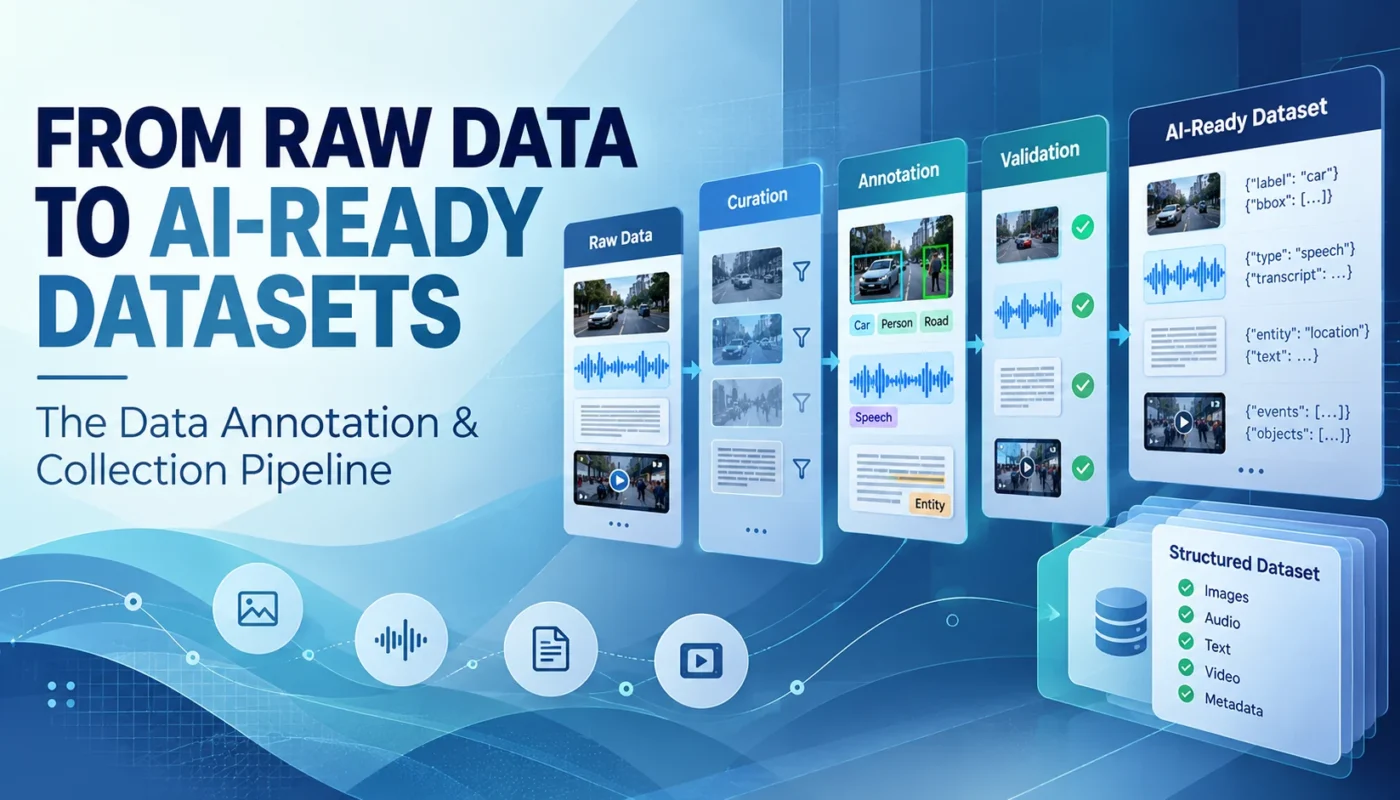
This is why building an AI-ready dataset is better understood as a pipeline rather than a single annotation task. Each stage has a role: getting the right data, preparing it, adding the required information, checking it, and finally turning it into a dataset that can be used for AI development.
The goal is not just to produce more labeled data. It is to make sure that every stage contributes to a dataset that is relevant, consistent, and useful for the model it is meant to support.
Starting With the Right Data
Before thinking about labels, it is worth asking a simpler question: do we actually have the right data?
An AI model can only learn from the examples it is given. If those examples do not cover the situations the model is expected to handle, adding more labels to the same data will not necessarily fix the problem. A speech model trained mostly on clear recordings, for example, may still struggle with different accents, background noise, or recordings made on everyday devices.
That is why data collection needs to be planned around the model’s requirements. The goal is not just to collect as many files as possible, but to make sure the dataset covers the people, environments, conditions, devices, languages, and situations that matter for the project.
can be more useful than a larger collection of repetitive examples.
The same idea applies to other types of data. An image dataset might need photographs taken from different angles and under different lighting. A robotics project may need recordings of tasks performed in different environments. A document dataset may need examples with different layouts, formats, and levels of complexity.
Sometimes the required data is already available, and the main challenge is turning it into something usable. In other cases, important examples are simply missing. That is when targeted data collection becomes part of the pipeline.If you’re trying to determine whether you need new data, annotation, or both, see Collection, Annotation or Both?
A useful way to look at the process is:
What does the model need? → What is missing? → What should be collected? → Capture the data → Review the results
The important part is that coverage should guide dataset growth, rather than simply increasing the number of similar examples.
Preparing Data Before Annotation
Once the data has been collected, the next step is to make sure it is actually ready for annotation. Raw datasets can contain duplicate files, corrupted recordings, irrelevant samples, poor-quality images, incomplete information, or different formats mixed together. Sending everything directly to annotators can make the process slower and introduce inconsistencies later.
Data preparation usually starts with filtering and organizing the dataset. Files that do not meet the project requirements can be removed, while useful data can be grouped according to factors such as language, location, data type, recording condition, or use case. For a large project, even keeping the file structure consistent can make a noticeable difference to the annotation workflow.
For instance, consider a team that has collected 10,000 customer-service audio recordings for a speech dataset. Before transcription begins, the files may be checked for duplicates, long periods of silence, excessive background noise, missing audio, or recordings that do not meet the required language or duration. Removing those issues first means annotators are not spending time working on files that cannot contribute to the final dataset.
The same applies to other types of data. An image may be too blurry to identify an object clearly, while a document may be missing pages or contain incomplete information. Catching these problems early is much easier than discovering them after the data has already been annotated.
Another important part is checking whether the dataset has the right coverage. If most of the collected examples come from one environment, device, language, or type of user, the dataset may still have gaps even if the total number of files looks impressive.
A simple way to think about this stage is:
→
→
→
→
The aim is not to make the data perfect before annotation. It is to remove avoidable problems and create a clear starting point so that the annotation process can focus on adding meaningful information to the data.
Turning Data Into Structured Information
Once the data has been collected and cleaned up, it needs to be turned into something an AI model can actually learn from. This is where annotation comes in. Instead of leaving an image, recording, video, or document as raw data, annotation adds the information that tells the model what it is looking at or hearing.
The type of annotation depends on the task. An image might need objects marked with bounding boxes or masks. A video could require actions, events, or objects to be tracked over time. Audio may need to be transcribed, separated by speaker, or matched with timestamps. Text can be labeled for things such as entities, intents, categories, or preferences.
But annotation is not simply a matter of adding as many labels as possible. The labels need to match what the model is actually expected to learn. If a vision model needs to understand the exact shape of an object, a simple bounding box may not be enough. In the same way, a speech model that needs to understand when a particular word was spoken needs more than just a transcript.
the model is expected to understand.
This is why the annotation rules need to be decided before large-scale labeling begins. Annotators need to know what should be labeled, how it should be labeled, and what to do when a case is unclear. Without clear rules, two people can look at the same piece of data and come up with different answers.
Take a customer-support dataset as an example. The sentence “I want to cancel my order” could simply be labeled as a cancellation request. But if the model also needs to understand why the customer wants to cancel, the annotation may need to capture additional information such as the intent, product, order status, and reason.
Some projects also need several layers of annotation on the same piece of data. A single video, for example, might contain object labels, action labels, timestamps, and an overall outcome. Adding these layers can make the dataset much more useful, but only when each one serves a clear purpose.
Ultimately, these labels become part of the information the model uses during training. They help the training process connect an input with the expected answer or behavior. Good annotation gives the model clearer examples to learn from; poorly defined annotation can teach it the wrong pattern.
The best starting point is therefore a simple question: What should the model be able to understand from this data? Once that is clear, it becomes much easier to decide what needs to be labeled, how detailed the annotation should be, and how those labels will support training and evaluation later.
Validating the Dataset Before It Reaches the Model
Once the data has been annotated, it can be tempting to consider the job finished. But before the dataset is used for training, there is one more important question: are the labels actually reliable?
Even with clear instructions, mistakes can happen. A label might be missing, an object might be marked incorrectly, a transcript could contain an error, or two similar cases might be labeled differently. A few mistakes may not seem important on their own, but repeated across thousands of records, they can start to affect what the model learns.
That is why annotated data needs to be reviewed against the project’s requirements. Depending on the type of dataset, this might mean checking a sample of annotations, looking for missing or inconsistent labels, or comparing the work with an agreed reference.For a deeper look at this process, see Perit’s approach to AI data quality.
A practical validation process can start with a sample of the completed annotations rather than reviewing everything from scratch. The selected items are checked against the annotation guidelines, and any problems are recorded. If a pattern starts to appear, the team can look beyond the individual mistake and check whether the same issue exists elsewhere in the batch.
For example, imagine a dataset containing thousands of vehicle images. During review, the team might find that some motorcycles have been labeled as cars or that certain vehicles were missed altogether. These mistakes are much easier to fix while the dataset is still being prepared than after a model has already been trained on them.
The review can then follow a simple loop:
Reviewing the data can also uncover a different kind of problem: the annotation instructions themselves may not be clear enough. If reviewers keep coming across the same confusing case, the problem may not be with the person doing the labeling. The guideline might simply need a better definition or another example.
This is why validation is not just a final check before delivery. It helps confirm that the annotations are following the same standard across the dataset and that the information being passed into training actually matches what the project intended to capture.
In the end, the goal is simple: the dataset should be more than large and heavily labeled. The labels should be consistent enough to give the model a reliable set of examples to learn from.
Structuring Data for Model Training
Once the annotations have been reviewed, the dataset still needs to be put into a format that people and machines can actually work with. Accurate labels are important, but they also need to be organized properly before the data reaches the training stage.
The structure depends on the type of data. An image dataset might link each image to its bounding boxes or segmentation masks. An audio dataset could include the recording along with its transcript, timestamps, speaker information, and other metadata. For documents, the final dataset might contain the original file alongside extracted fields or other annotations.
Metadata also becomes useful at this stage. Information such as the language, source, recording conditions, device, or annotation type can help teams understand and filter the dataset later. Keeping each annotation connected to the original file also makes mistakes easier to trace and correct.
For larger projects, the data may be divided into training, validation, and test sets so that the model can be trained on one portion and evaluated on data it has not seen before. Dataset versioning is useful as well, particularly when new data is added or existing annotations are corrected.
At this point, the goal is not simply to have a folder full of labeled files. The dataset should have a consistent structure, useful metadata, traceable annotations, and clearly defined versions.
This is where the earlier stages come together. Data that has been collected carefully, prepared properly, annotated consistently, and reviewed thoroughly is much easier to move into the actual AI development process.
Adapting the Pipeline to Different Data Types
The overall pipeline may look similar across projects, but the actual work can change quite a bit depending on the data. An image, an audio recording, a video, and a document all go through collection, preparation, annotation, and review, but each one brings its own problems.
Take image data. The collection process may need images from different angles, lighting conditions, environments, or object types. Once the images are ready, they might need bounding boxes, segmentation masks, or other labels depending on what the model needs to recognize.
Audio data has a different set of challenges. Recordings may come from different speakers, accents, devices, and environments. A dataset might need transcripts, speaker information, or timestamps. Background noise or people speaking at the same time can also make the annotation harder.
With video, the main difference is that the data changes over time. A single frame may not tell the whole story, so annotation can involve tracking an object across frames or marking when a particular action or event starts and ends.
Text and documents bring their own requirements. Text might need labels for entities, intent, or categories, while documents may need specific fields, tables, or sections to be identified. In these cases, the structure of the document can be just as important as the words themselves.
So while the basic pipeline stays the same, the rules around it need to change with the data. A good data operation is not about forcing every dataset through exactly the same process. It is about keeping the overall workflow consistent while adapting each stage to what the model actually needs to learn.
Scaling the Pipeline Without Losing Consistency
A pipeline that works for a few thousand files can look very different when the dataset grows to millions. More data means more people, more batches, more edge cases, and more opportunities for small differences to creep into the process.
same standards in place as the dataset grows.
One of the first challenges is keeping the same standards across the dataset. Different annotators may interpret an unclear case differently, or teams working on separate batches may start following slightly different assumptions. If those differences are not caught early, they can become part of the final dataset.
Scaling also means keeping track of where the data came from and what happened to it along the way. A large project may have data collected at different times, annotations updated in multiple rounds, and new samples added as the project evolves. Without proper organization and versioning, it becomes difficult to know which data is current or why a particular annotation was changed.
This is where Perit AI’s data operations become useful. Perit can support the pipeline with data collection and annotation workflows built around the requirements of a specific project, rather than treating every dataset the same way. That can include recruiting contributors against defined requirements, running pilots before larger collection, organizing annotation workflows, and using sampling and review to keep batches on track.
The approach also changes with the type of data. Perit’s collection work covers areas such as speech and audio, video, images, and text and conversation, while annotation workflows can be adapted to the labels and structure each project requires. For larger operations, the focus is not just on getting more contributors involved, but on making sure they are working from the same protocol and that the resulting data can be reviewed and traced across batches.
That makes scaling less about simply adding more people and more about building a process that can keep working as the dataset grows. Clear guidelines, organized batches, project-specific workflows, and regular review give teams a way to increase volume without letting every new batch become a completely separate process.
For AI teams, that matters because more data is only useful when the additional data remains usable. Perit’s role is to help turn a growing volume of raw inputs and annotations into a more organized, repeatable data operation that teams can continue building on.
Closing the Loop Between Data and Model Performance
Building a dataset does not always end when the data reaches the training stage. Once the model is tested, its results can reveal problems that were not obvious when the dataset was being prepared.
A model might work well on most inputs but struggle with a particular accent, environment, object, or document format. Sometimes the issue is not the model itself. The training data may simply not contain enough examples of that situation.
This is where the data pipeline starts to work as a loop rather than a straight line. Model results can show where the dataset has gaps, and those gaps can guide the next round of collection or annotation.
For example, a speech model might perform well on clear recordings but struggle when there is background noise. Instead of adding more clean recordings, the next collection round could focus on noisy environments and different recording conditions. Those new recordings can then go through the same preparation, annotation, and validation process before being added to the dataset.
The same idea applies when the problem is with the labels themselves. If testing shows that the model keeps confusing two similar categories, the team may need to look back at how those cases were annotated and whether the existing guidelines captured the difference clearly enough.
This is also why keeping the earlier stages organized matters. When data is linked to its source, metadata, annotation version, and other relevant information, it becomes much easier to understand where a problem came from and what needs to change.
Perit AI can support this ongoing process by helping teams collect new data or expand existing annotation workflows when new gaps are identified. The dataset can continue to evolve instead of being treated as a one-time deliverable.
In practice, the first dataset is often just the beginning. What the model gets wrong can tell you what data you need next.
What an AI-Ready Data Pipeline Looks Like
By this point, it should be clear that an AI-ready dataset is not created by annotation alone. It comes from several connected steps, starting with the right raw data and ending with data that is organized, reviewed, and ready to use.
Sometimes the process starts with something as simple as a missing example. Maybe the model needs more recordings from a certain environment, more images of a particular object, or better labels for a type of document. That requirement then works its way back through the pipeline: collect or select the data, prepare it, annotate it, review it, and structure it for use.
What makes the pipeline useful is how these stages connect. Good collection gives annotators better data to work with. Clear annotation makes the data easier to review. Good structure makes it easier to manage. And model results can show what needs to be added or changed next.
For Perit AI, this means supporting the data work across these stages rather than treating collection and annotation as isolated tasks. The workflows can be adapted to different data types and project requirements, giving teams a structured way to build and expand their datasets as their needs change.
The goal is not simply to end up with a large number of labeled files. The data needs to be relevant, consistently annotated, properly structured, traceable, and useful for the problem the model is actually trying to solve.
consistent validation, and a process that can keep improving.
The result is a dataset that can evolve with the model. It takes the right inputs, the right labels, a consistent process, and enough feedback to keep improving the dataset as the model evolves.