
Microsoft Maia 300 reflects a growing shift in AI infrastructure. Companies are no longer focused only on building more powerful AI models. They are also trying to make those models faster and more efficient to operate. Through its custom AI accelerators, Microsoft aims to improve inference efficiency, manage data centre costs, and support increasingly complex AI applications. This article explores how Maia 300 works, how it builds on earlier Maia generations, how it compares with competing chips, and what its development could mean for the future of AI. [1]
The central question
How can AI infrastructure deliver more useful output while reducing the energy, memory, and computing resources required for every response?
The focus is not peak performance alone, but the efficiency of the complete inference system.
Why Microsoft Is Rethinking AI Inference
The AI race is no longer just about building more capable models. It is also about running them efficiently. Every time an AI assistant answers a question, generates code, or processes a long document, data moves between memory and processors while calculations consume electricity and computing resources. At millions of requests per day, these demands quickly become expensive.
This is where inference becomes important. Training teaches a model to perform a task, while inference is the process of using that trained model to generate responses. As AI applications become more interactive and handle longer conversations, inference systems must balance speed, memory capacity, energy consumption, and the number of users they can serve simultaneously.
01 User request
Prompt or input enters the AI service.
02 Model and memory access
The system retrieves parameters and relevant context.
03 Accelerator computation
The model processes the input and calculates the next token.
04 Token generation
Output is generated repeatedly until the response is complete.
Figure 1. Simplified AI inference workflow, illustrating how a request moves through model and memory access, accelerator computation, and token generation. Conceptual illustration, not a hardware-specific Maia 300 architecture diagram.
Microsoft’s Azure Maia programme is an attempt to address this challenge through custom silicon. With Maia 300, announced in October 2026, Microsoft is focusing on infrastructure designed for large-scale inference, including long-context reasoning and multi-step AI agents. Production deployment is planned for 2027. [1]
The idea is straightforward. A chip designed around Microsoft’s workloads may use resources more effectively than a general-purpose alternative. But the real advantage will depend on more than the processor itself. Memory, networking, software, cooling, and workload scheduling all influence how efficiently an AI system operates.
From Maia 100 to Maia 300
Microsoft introduced Maia 100 in November 2023 as part of a broader effort to design its own cloud infrastructure. The accelerator was developed for AI workloads, including training and inference, and marked Microsoft’s move towards controlling more of the hardware underlying its services. [1]
The next generation, Maia 200, arrived in January 2026 with a stronger emphasis on inference economics. Microsoft lists 216 GB of HBM3e memory, 7 TB/s of memory bandwidth, and peak performance exceeding 10 petaFLOPS at FP4 precision. These specifications show the direction of the design, although actual performance varies with the model, workload, and software implementation. [3]
Maia 200 also moved into production use. Microsoft has reported deploying it for Copilot and its own AI model development, with further workloads planned for GitHub Copilot and Microsoft Foundry. This provides a useful indication of how the Maia programme is being used beyond the announcement stage. [3]
Maia 300 extends that approach with a chiplet-based design and HBM4 memory. Microsoft describes eight HBM4 stacks providing 288 GB of capacity and 18 TB/s of bandwidth, alongside a planned rack configuration containing 96 accelerators. These figures suggest a substantial increase in memory capacity and bandwidth over Maia 200, but independent production-scale testing will be needed to establish how those improvements translate into application performance. [1]
How the Maia family evolved
| Feature | Maia 100 | Maia 200 | Maia 300 |
|---|---|---|---|
| Primary focus | AI training and inference | Inference economics | Large-scale inference |
| Memory | Not compared here | 216 GB HBM3e | 288 GB HBM4 |
| Memory bandwidth | Not compared here | 7 TB/s | 18 TB/s |
| Deployment | Earlier generation | Reported production use | Planned from 2027 |
Table 1. Specifications and deployment descriptions should be verified against Microsoft’s original documentation before publication.
How Maia 300 Works
An AI accelerator needs to do more than perform calculations quickly. It must also obtain model parameters and intermediate data without keeping its compute resources waiting. This is one reason memory bandwidth and data movement have become central to AI chip design.
According to Microsoft’s architecture deep dive, Maia 300 separates compute chiplets from memory-controller and input/output functions. This allows different parts of the processor to be designed around their specific requirements rather than forcing every function into a single large die. [2]
Its HBM4 memory is intended to help supply data to the compute units at high speed. The accelerator also supports low-precision computation, including MXFP4, which can reduce the amount of data moved and increase computational throughput for suitable workloads. The trade-off is that lower numerical precision must be managed carefully to preserve model quality. [1]
TECHNICAL NOTE
Lower precision is a trade-off, not a free performance gain.
Reduced numerical precision can improve throughput and reduce data movement, but model quality must be validated for the workload being served.
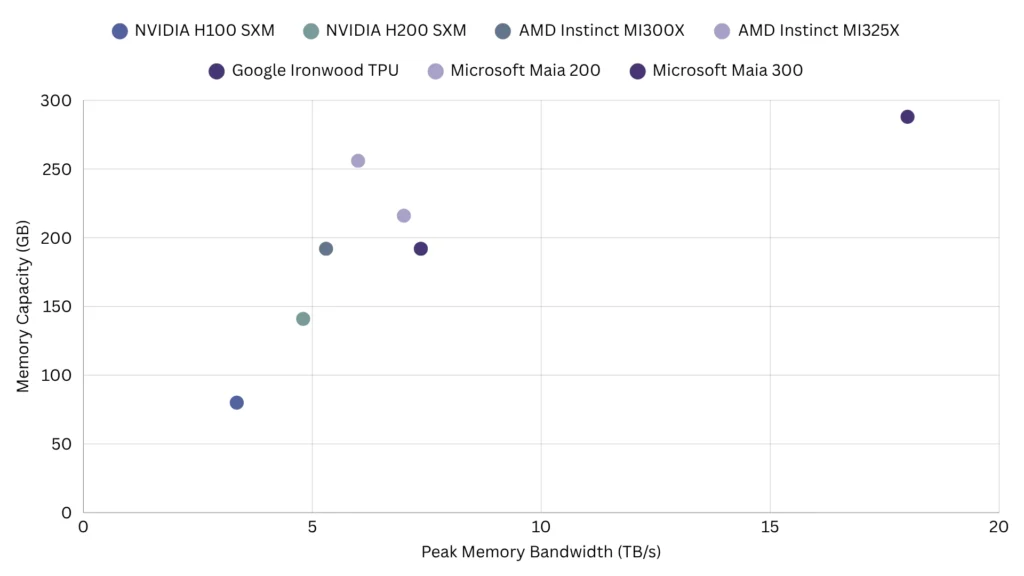
Ultimately, Maia 300 should be viewed as part of a complete AI-serving platform. Its practical value will depend on how effectively the chip, software, memory, networking, and data centre infrastructure operate together.
Measuring AI Efficiency
Peak performance is an important specification, but it does not tell the whole story. A chip may perform exceptionally well in a controlled benchmark and still deliver less impressive results when serving real users with different models, context lengths, and response-time requirements.
Energy per generated token
EtotalNtokens
Etotal is the energy consumed during the measured run.
Ntokens is the number of generated tokens.
Lower energy per token indicates better energy efficiency when the workload and measurement boundaries are comparable.
One useful measure is token throughput, which describes how many tokens a system generates in a given period. Energy efficiency considers how much electricity is needed to produce those tokens, while cost per token helps operators understand the economics of serving AI applications. These measurements are most useful when workload, model quality, latency, and hardware configuration are comparable.
Microsoft expects Maia 300 to deliver 40% more tokens per megawatt than leading GPU-based systems. In a full rack configuration with 96 accelerators, the company also claims up to seven times the rack-scale token throughput of Maia 200. These figures reflect Microsoft’s stated expectations for the new system, rather than independently verified benchmark results. Actual efficiency will depend on the model, workload, hardware configuration, and software optimization. [1]
Memory bandwidth is another important factor, particularly during token generation. Large language models repeatedly access model parameters and previously calculated information, so additional compute capacity may not help much when data movement is the limiting factor. This is why a balanced comparison must consider throughput, latency, memory, power consumption, and operating costs rather than relying on a single headline number. [1] [3]
Inference cost per million tokens
C1M =
CservingNtokens
× 106
Cserving is the total serving cost for the measured run.
Ntokens is the number of tokens generated.
A lower value indicates a lower serving cost per million generated tokens when model quality and workload are comparable.
Maia 300 vs NVIDIA, Google, and Amazon
Microsoft is entering a competitive market in which cloud providers are increasingly designing their own AI accelerators. NVIDIA remains a major force through its GPU platforms, supported by a mature software ecosystem, developer tools, libraries, and networking technologies. These advantages matter because customers need hardware that works reliably with their models and existing development workflows. [4] [5]
AI accelerator landscape
| Platform | Approach | Key consideration |
|---|---|---|
| Microsoft Maia | Custom accelerator for Azure infrastructure | Integration with Microsoft’s services and software |
| NVIDIA GPUs | Broad-purpose accelerated computing | Mature developer ecosystem and broad workload support |
| Google TPU | Custom accelerator for Google Cloud | Integration with Google’s AI software stack |
| AWS Trainium | Custom accelerator for AWS | Integration with AWS services and Neuron software |
Table 2. This is a qualitative comparison of platform strategies, not a benchmark ranking.
Sources: Official platform and product documentation. This is a qualitative comparison of platform strategies, not a benchmark ranking. [1] [4] [7] [8]
Google has taken a similar custom-silicon approach with its Tensor Processing Units. Its seventh-generation Ironwood TPU is designed with inference workloads in mind, making it a relevant comparison for Maia 300. Both reflect the growing importance of efficient model serving, although their architectures, software environments, and deployment models differ. [7]
Amazon’s Trainium family targets AI training and inference within AWS. Its Neuron software stack connects the hardware to model development and deployment. For customers already using AWS, this integration can be as important as raw processor performance. [8]
The key difference is that these platforms do not necessarily target identical workloads. NVIDIA offers broad flexibility, while Google, Amazon, and Microsoft can optimize their custom accelerators around their respective cloud environments. Comparing them fairly requires equivalent models, numerical precision, latency targets, and measurement conditions.
Maia 300’s potential advantage lies in Microsoft’s ability to coordinate the accelerator with Azure and its own AI services. However, software maturity, availability, portability, and independently verified performance will determine how attractive it becomes to external customers.
Industry Response and Real-World Experience
There is an important distinction between the response to Maia 300’s announcement and feedback from people who have actually used it. Since production deployment is planned for 2027, there is not yet a basis for presenting widespread firsthand customer reviews of Maia 300 itself.
EVIDENCE CHECK
An announcement is not a customer review.
Maia 300’s production performance must be evaluated after deployment. Maia 200’s reported results provide context, but they are not direct evidence of Maia 300 performance.
Industry coverage, including reporting from Reuters and The Verge, has focused on Microsoft’s investment in custom silicon and its effort to expand its AI infrastructure. This reflects a broader industry shift, but reporting on the strategy should not be mistaken for independent testing of the chip. [9] [10]
Maia 200 offers a more concrete picture of the programme’s progress. Microsoft reports that it is already serving Copilot and supporting internal model development. The company has also published efficiency claims for selected AI workloads. These reports demonstrate operational use, although independent measurements would be needed to establish how the results compare with competing hardware under equivalent conditions. [9] [10]
For everyday users, better inference infrastructure could eventually mean more responsive AI applications or greater capacity during periods of high demand. For developers and enterprises, the benefits could include improved serving economics and additional deployment options. Neither outcome is automatic. Application performance also depends on the model, software, service configuration, and workload.
The most useful future reviews will examine actual throughput at defined latency targets, energy consumption, reliability, supported models, and total operating cost. They should also assess how easy the hardware is to program and maintain. For now, Maia 300 has a promising architectural direction, while its production performance and reception among customers remain to be established.
What Maia 300 Means for the Future of AI
As AI systems take on longer conversations, complex reasoning, and multi-step tasks, the infrastructure required to operate them is becoming increasingly important. Data centres must deliver more computing capacity while managing electricity, cooling, manufacturing costs, and reliability. Improving inference efficiency is therefore a practical requirement for scaling AI, not simply a benchmark competition.
Custom accelerators offer cloud providers greater control over how their hardware is designed and deployed. Microsoft’s Maia programme reflects this approach, combining chip development with its cloud infrastructure and software environment. If Maia 300 delivers its intended efficiency improvements, it could help Microsoft serve more AI workloads within existing power and infrastructure limits. [1]
There are trade-offs. Custom silicon requires significant investment and ongoing software development, and a design optimized for one workload may not be ideal for another. Microsoft must demonstrate that Maia 300 can support evolving models, deliver predictable performance, and offer a compelling experience to developers and enterprise customers.
The wider industry is likely to remain heterogeneous, with different accelerators serving different workloads. NVIDIA’s established ecosystem, Google’s custom TPUs, Amazon’s Trainium, and Microsoft’s Maia each offer different combinations of hardware and software. The best choice will depend on the application, model, performance requirements, and cost.
Maia 300 represents Microsoft’s effort to improve AI inference through custom hardware and system-level optimization. Its planned production deployment in 2027 will provide a clearer picture of its real-world performance, efficiency, and competitiveness. Until then, its long-term value will depend on how effectively it translates its architectural design into reliable, cost-efficient AI services at scale. [1]
The ultimate measure of success will be simple. How reliably and economically can Maia 300 deliver useful AI output at scale?
References
- Microsoft.
Maia 300 Announcement. 2026. - Microsoft Azure.
Deep Dive into Maia 300 Architecture. 2026. - Microsoft.
Maia 200: The AI Accelerator Built for Inference. 2026. - NVIDIA.
H100 GPU Specifications. - NVIDIA.
H200 GPU Specifications. - AMD.
Instinct MI300 Series Specifications. - Google.
Ironwood: The First TPU for the Age of Inference. 2025. - Amazon Web Services.
AWS Trainium: AI Accelerator Overview. - Reuters.
Microsoft’s Planned Deployment of Its Own AI Chips. 2026. - The Verge.
Microsoft Maia 300 Chip and Rollout Coverage. 2026.