In short
- LensVLM gives a vision-language model a compressed visual overview of a document, then lets it expand selected pages into readable text or high-resolution images.
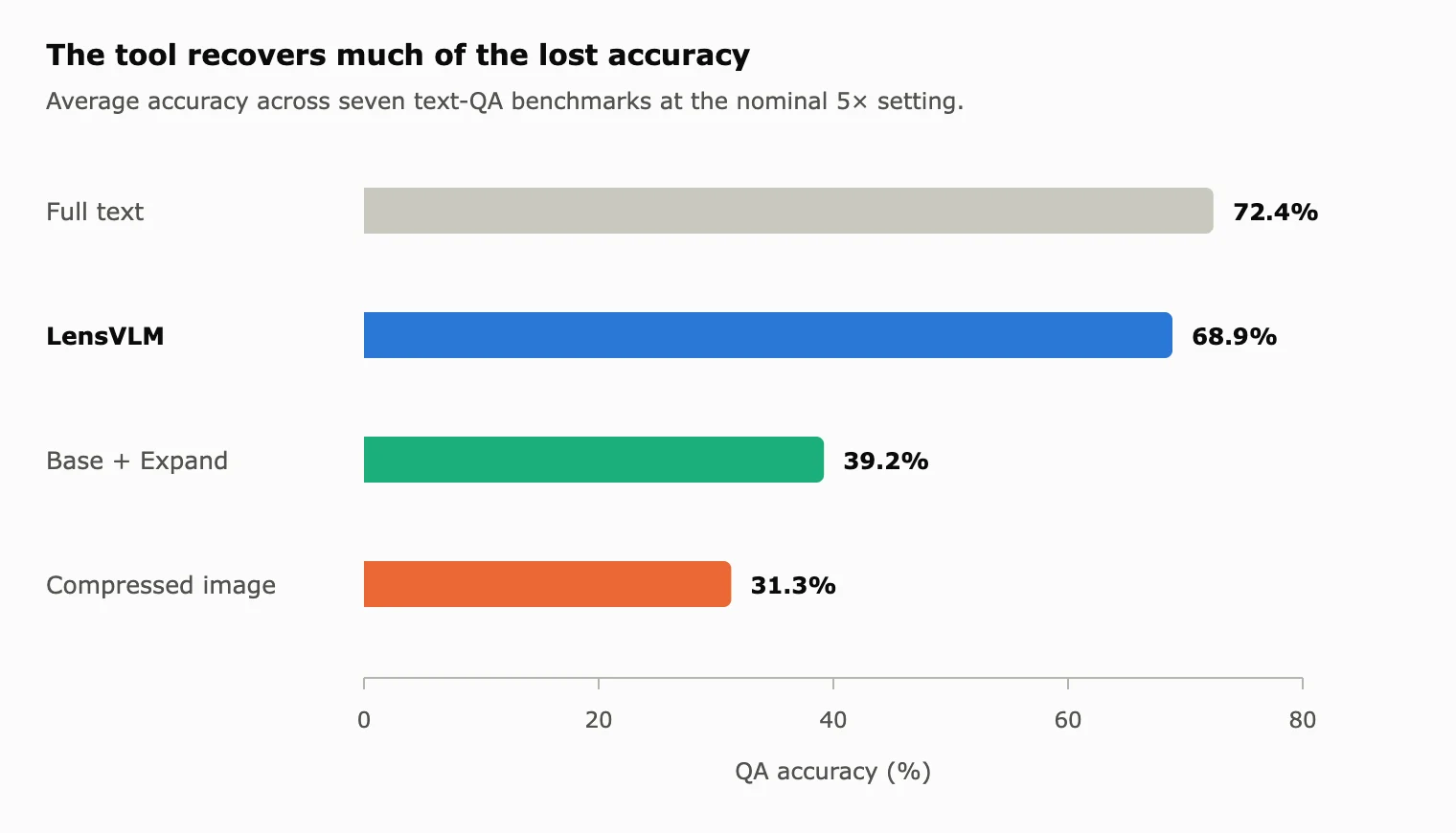
- On seven text question-answering benchmarks, the paper reports 68.9% average accuracy at 4.3× effective compression, compared with 72.4% when the same backbone receives the full text.
- The saving is smaller than the initial image compression because expanded passages, tool responses, and later turns still consume context.
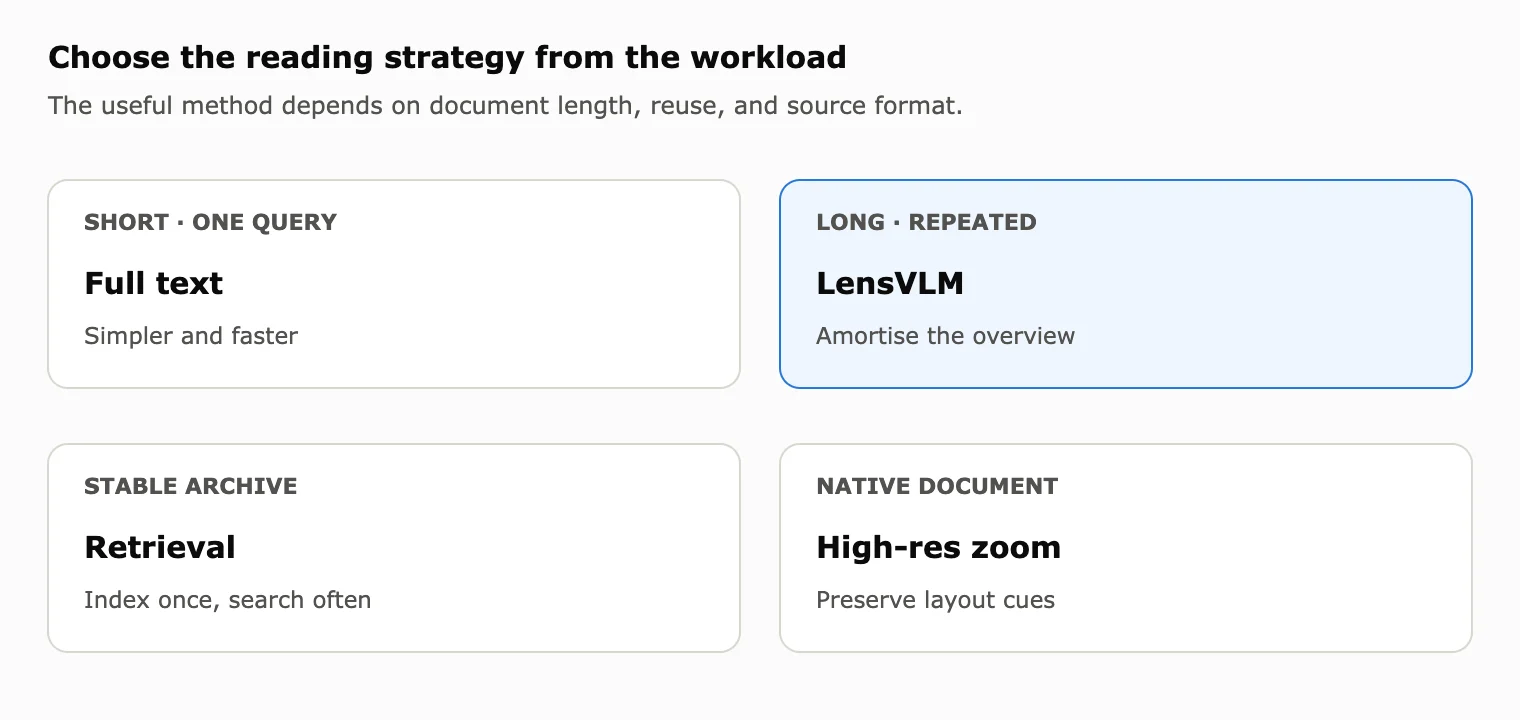
- Full text remains faster for short, one-off questions. LensVLM becomes more attractive for long documents and repeated queries, where shorter contexts reduce memory and prefill work.
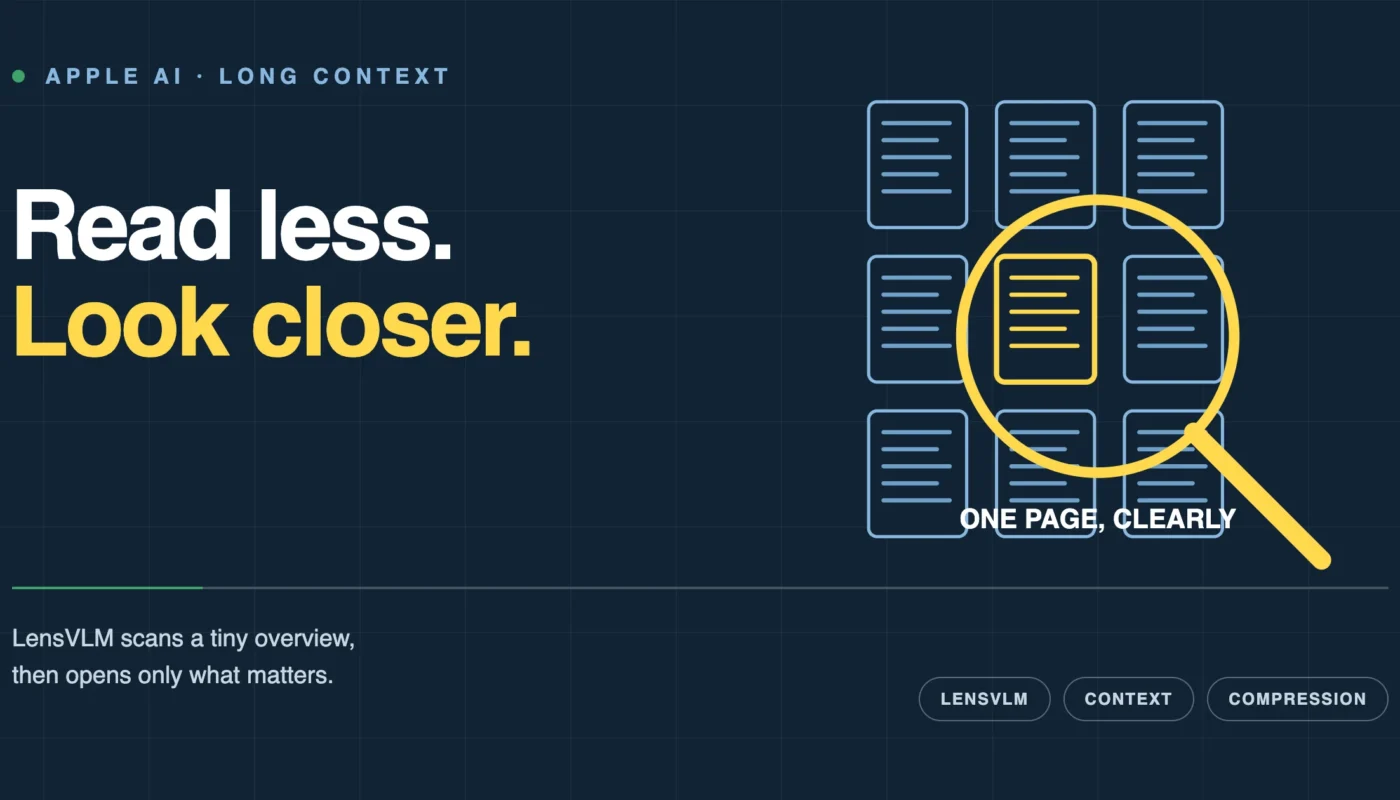
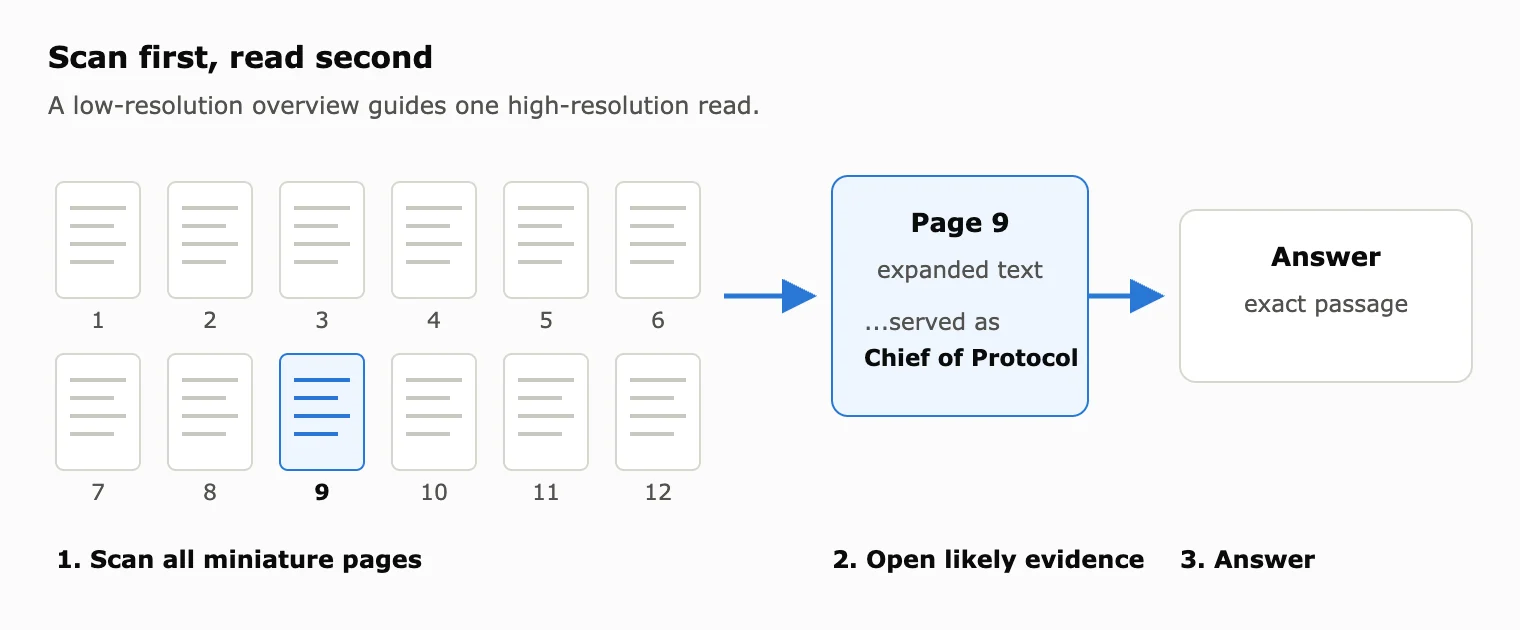
Fifteen pages appear in front of an AI. They are not fifteen normal pages. Each has been shrunk until it resembles the miniature preview beside a search result: columns, headings, and scraps of language compressed into a small rectangle.
The question seems to belong in a quiz show. What government position was held by the woman who played Corliss Archer in the film Kiss and Tell?
The model scans the miniatures. Page ten contains the faint outline of a promising biography. It asks to read that page again. The system returns the original text, now clear enough to name Shirley Temple and follow her career beyond Hollywood. The answer arrives on the second turn: Chief of Protocol of the United States.
This is the example in the official LensVLM repository. Its charm is that the first view is not expected to contain the complete answer. It only has to tell the model where to look.
That changes the usual bargain of long-context AI. Most systems either load every word, retrieve a few passages before the model begins, or discard material through compression. LensVLM keeps a rough view of everything and gives the model a way to reverse the compression locally.
The question behind the work is larger than screenshots or token counts. Does an AI need every word at full resolution throughout a task, or can it read the way people often do: glance first, focus second?
The strange economy of turning words into pixels
A language model normally receives text as tokens. Common words may occupy one token. Unusual names, numbers, and fragments can occupy several. A long report therefore becomes a long sequence that the model must hold and process.
A vision-language model offers another route. Render the report as page images and pass those images through a vision encoder. The encoder converts each page into visual tokens. If the rendering is dense enough, one visual token can stand in for several text tokens.
This sounds like free context. It is not.
Imagine printing a contract on a sheet of paper and photographing it from farther away. The file still contains the whole page. The title may remain obvious. The shape of a table may survive. A clause in eight-point type eventually becomes a row of nearly identical marks.
The same failure appears in visual tokens. Compression can preserve a coarse map after it destroys the letters needed for an exact answer. The LensVLM paper, first submitted on 7 May 2026 and revised to version four on 9 October, begins with that limit. Characters shrink below the vision encoder’s useful resolution. Accuracy falls quickly because the information is present in principle and unreadable in practice.
Earlier work had already explored language as pixels. PIXEL showed that models can process rendered text without a conventional tokenizer. Later systems improved layouts, trained stronger visual readers, or learned which material to render. LensVLM makes a different move. It accepts that the compressed view will fail to preserve every letter.
The overview has one job: point toward evidence. The expansion tool has another: recover the evidence in a form that can be read precisely.
That division is the whole idea.
Compression becomes reversible
LensVLM starts with a deterministic renderer. Source text is divided into pages and drawn into images using a fixed font, geometry, and spacing. Those images are deliberately small. In the paper’s three settings, the vision encoder represents each image with 72, 48, or 24 visual tokens.
The model receives every compressed page plus the question. It can answer immediately or call an Expand tool on a page number. The tool returns the source passage as text. For a native document whose layout carries meaning, it can instead return a higher-resolution image.
If the answer needs two pages, the model can open them one at a time. Each decision can use what the previous page revealed. The paper allows up to six turns, although the trained model averages 1.3 expansions per trajectory.
Nothing new enters the document. Expansion only presents selected material in a more readable form. That point matters because “zooming in” can sound like a visual enhancement trick. For rendered text, the most effective tool usually returns the underlying text itself. For scans, forms, and richly formatted documents, the high-resolution image can be better because OCR may discard layout cues.
The model therefore behaves less like a person squinting harder and more like a reader using a table of contents. The compressed pages provide orientation. The original source remains available behind them.
This is also where LensVLM differs from ordinary retrieval. A retrieval system builds or searches an index, chooses passages, and hands only those passages to the reader. LensVLM lets the reader see a compressed global view and make selections inside the same multi-turn process. Retrieval commits before the reader starts. LensVLM can revise its choice after opening a page.
Neither arrangement is universally better. Retrieval is mature, fast, and excellent when documents are stable enough to index. LensVLM is interesting when global layout or evolving reasoning helps determine what should be opened next.
The 4.3× number includes the second look
The paper separates two kinds of compression.
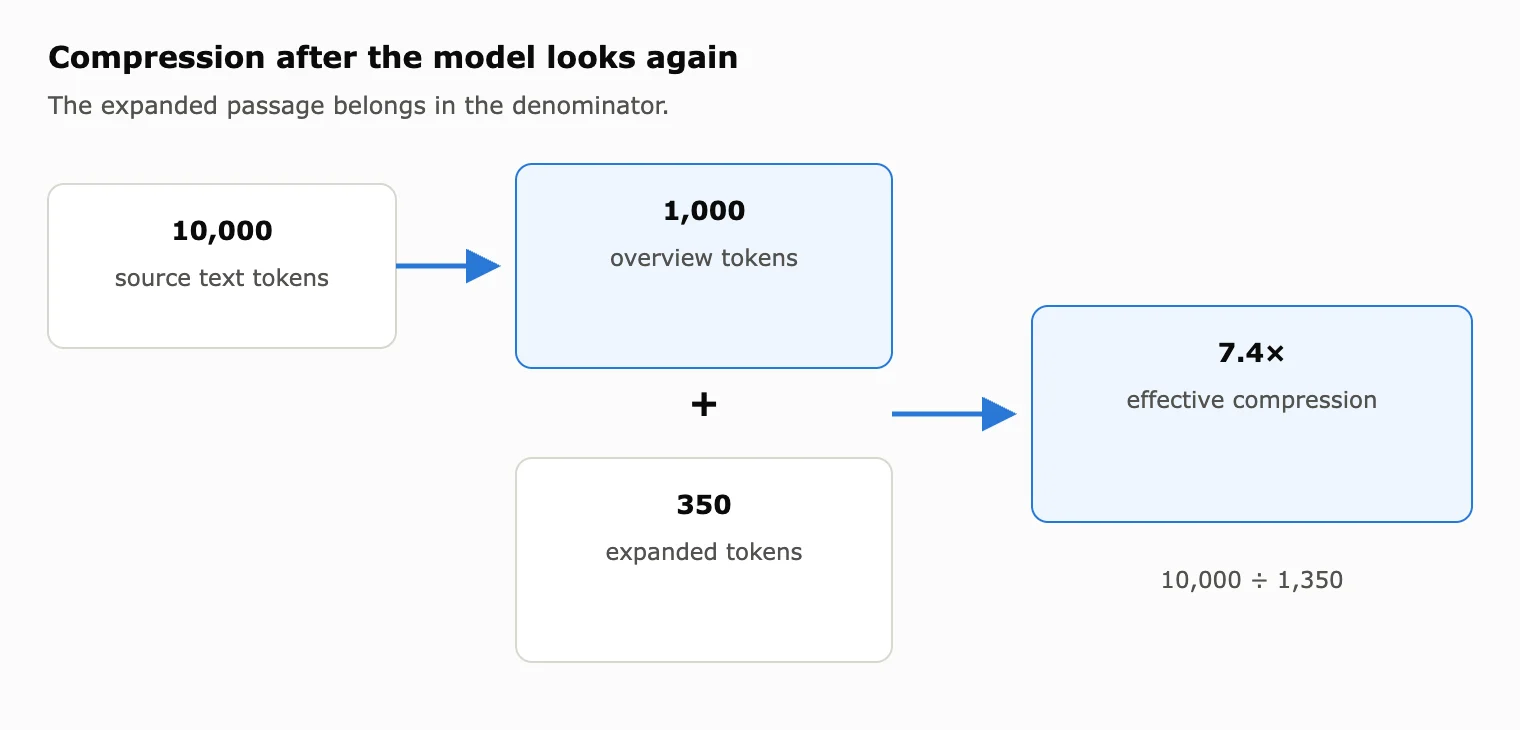
Input compression describes the first view: how many original text tokens are represented by the visual tokens in the thumbnails. Effective compression describes the entire reading bill after expanded passages have been added.
Suppose a document contains 10,000 text tokens. Its compressed overview might consume 1,000 visual tokens, which looks like 10× compression. If the model later opens passages containing another 350 tokens, the reader has processed 1,350 input tokens. Effective compression is about 7.4×, not 10×.
The exact accounting in the paper follows this principle. Expanded content counts. Tool responses count. A method does not earn a 10× label merely because its first frame was 10× smaller.
That is why the headline result is 4.3× effective compression at the nominal 5× setting. The model spends some of its saving to recover detail. At nominal 10× and 15×, the reported effective rates are 7.4× and 10.1×.
This is good measurement discipline. Selective expansion moves cost rather than making it disappear. The claim is that paying for a small overview plus a few exact passages can be cheaper than keeping the full document active from the start.
A miniature page is a good map and a bad witness
The clearest result in the paper is also the simplest.
Across seven text question-answering benchmarks, giving the Qwen3.5-9B backbone the full text produces an average score of 72.4%. Rendering the same material as compressed images at the nominal 5× setting drops the score to 31.3%. More than half the useful accuracy disappears.
The compressed pages still contain the document. The model can still see them. It simply cannot recover enough exact language from the pixels.
Adding an expansion tool to the untrained base model raises the score to 39.2%. The model already has some ability to choose a useful page. Training it for the complete behaviour changes the result much more: LensVLM reaches 68.9% at 4.3× effective compression.
That is what “comparable to the full-text upper bound” means in this experiment: 68.9% versus 72.4%, averaged across the seven selected benchmarks. It does not mean the outputs are identical, or that 4.3× is guaranteed for an arbitrary company archive.
At stronger compression, the trade becomes harsher. LensVLM reports 62.1% at 7.4× effective compression and 52.1% at 10.1×. The system continues to outperform fixed visual compression and token-pruning baselines, but accuracy still falls as the overview loses the clues required to select the right page.
Selection itself is measurable. The paper asks whether at least one expansion reaches a ground-truth evidence image. The trained model reports selection accuracy of 76.8%, 71.0%, and 52.1% across the three compression settings. At the strongest setting, the map is becoming too faint to guide the reader reliably.
There is a useful enterprise lesson in that decline. Compression errors can occur before any answer is written. If the overview sends the model to the wrong page, perfect reading of that page cannot recover the missing evidence. A production evaluation should score page selection and final answers separately.
The model is trained to admit when the overview is insufficient
LensVLM is built on Qwen3.5-9B-Base, an image-and-text model. The researchers do not retrain its vision encoder. They freeze the vision components and update the language model so it learns how to inspect, select, expand, and answer.
The training process has three parts.
First, the base model attempts questions using compressed pages alone. Examples it already answers correctly are labelled easy. Failures become the hard set, where opening evidence should be useful.
Second, a larger model receives the question, the correct answer, and the uncompressed evidence. It writes example trajectories showing when to call the tool and how to use the returned passage. These traces teach the 9B model the basic routine.
Third, reinforcement learning lets the model practise under its own choices. The reward favours correct answers and gives an additional reward for tool use only when the answer is correct. This creates a deliberate bias toward opening a page when uncertain. The authors argue that one unnecessary expansion is cheaper than a wrong answer caused by refusing to read.
The training set is substantial. It contains 143,145 generated examples from Natural Questions, HotpotQA, MuSiQue, and HELMET. About 105,000 are classified as hard. A typical example contains roughly 9,800 text tokens rendered into about 25 images. The main evaluation includes 2,400 held-out examples from those datasets, plus out-of-distribution tests drawn from Qasper, LongBench, and RULER.
The default recipe is not lightweight. Synthetic traces and answer judging use Qwen3.5-397B, and the paper reports training and evaluation on eight B200 GPUs. This is research-scale post-training, not a weekend fine-tune on a laptop.
The authors test smaller dependencies. A 27B synthesis model reduces the final score by 2.7 to 5.1 points. Exact-match rewards can replace the large answer judge, though they punish correct paraphrases. Synthetic evidence labels can replace hand-marked spans at a cost of 1.8 to 3.7 points. The full recipe is expensive, but its ingredients are not all mandatory.
There is an even lighter result: prompting an unmodified model to select and expand already improves both the open 9B backbone and a frontier model. Training makes the behaviour much more reliable. The framework and the trained checkpoint should be treated as separate contributions.
The cost moves from reading to choosing
Long context has two recurring costs. The model must first ingest the prompt, usually called prefill. It must then retain an internal cache so later generated tokens can refer back to that prompt. Shortening the reader’s context reduces both.
LensVLM adds different costs. Text must be rendered. The model may need another turn after an expansion. The newly opened passage must be ingested. Tool use also produces extra generated tokens.
The paper’s hardware profiling shows why workload shape matters. For a short document at 5× compression, full text completes in 1.44 seconds. The cached LensVLM path takes 1.77 seconds. The clever system loses because its setup and second turn cost more than simply reading the short input.
For a long document at 15×, the ordering changes. Full text takes 3.62 seconds, while cached LensVLM takes 2.52 seconds. The model’s initial prefill falls from 2.07 seconds to 0.21 seconds, even after LensVLM pays 0.13 seconds to ingest expanded content again.
These timings were measured in the authors’ B200 environment. They are evidence about the relative system design in that setup, not laptop latency or a universal serving forecast.
The memory result may matter more for enterprise systems. In the reported long-context tests, LensVLM’s key-value cache is 5.9 to 14.1 times smaller than full text. At the strongest compression, the paper reports 3.7× higher throughput and 3.7× lower serving cost. Those gains assume a long context and cached, reusable rendered pages.
A compliance team asking one question of a six-page policy should send the text. A support platform asking thousands of questions across lengthy manuals may benefit from a reusable overview. The architecture only pays when the document is long enough, or popular enough, to amortize the map.
Pictures of text are not the same as documents
The title of this article hides a distinction. LensVLM performs its strongest experiment on text that the researchers render into images themselves. The source text is still available, perfectly indexed by page, and can be returned by the expansion tool.
A scanned invoice is different. It may contain handwriting, stamps, charts, faint photocopying, and relationships encoded by position. There may be no clean source text waiting behind the pixels.
The paper tests this case on native document images. At mild 5× compression, reading the compressed pages directly scores 51.2%, slightly above the 50.5% result from zooming. The overview remains readable, so the extra tool call contributes little and sometimes selects the wrong page.
At 15×, the zoom tool becomes valuable: 41.9% versus 31.1% for compressed-image reading. Returning OCR text also helps, but trails high-resolution images because OCR throws away layout and visual evidence.
The practical rule is pleasingly concrete. When the system created the picture from clean text, reopen the text. When the original is a visual document, reopen the image.
That rule also defines the data needed to train and test the system. Rendered-text examples need reliable mappings from page images back to source spans. Native documents need page-level evidence and questions whose answers depend on layout, marks, tables, or nearby labels. A benchmark containing only clean digital prose cannot establish document understanding.
What LensVLM does not establish
It does not show that images are a richer representation of prose than text. Raw text remains the accuracy reference, and direct visual reading performs badly once letters become too small.
It does not remove retrieval from the design space. Strong text retrievers remain competitive in the paper. They pay for indexing before the query; LensVLM pays for rendering and lets the reader perform selection. Existing archives with reliable search may prefer the index they already operate.
It does not prove that every long task tolerates the same loss. The evaluation focuses heavily on questions with identifiable evidence pages. Summarising an argument distributed across an entire book is different from finding one clause. So is comparing subtle language across twenty versions of a policy.
It does not make compression free. Effective compression is lower than the first-view setting, and multi-turn inference adds latency. The source must remain stored because the compressed overview cannot regenerate details it erased.
It also does not make the training recipe small. The released LensVLM-9B model makes inference available, while reproducing the paper’s post-training still calls for considerable data and compute. The code uses the Apple Sample Code License, and the weights use Apple’s research model licence; deployment teams should read both rather than treating “released” as a single permission.
A useful evaluation begins with the lost detail
An enterprise pilot should start with a failure, not a compression target.
Choose a document collection and write questions that expose what must survive. In an insurance policy, that may be an exclusion, a date, and a definition spread across two pages. In a maintenance manual, it may be a warning attached to one diagram. In a contract, it may be the word “not” inside an exception to an exception.
Build references that identify both the answer and the evidence pages. Then score four events: whether the overview led to the right page, whether expansion returned the right content, whether the final answer was correct, and what the complete request cost.
Run full text, existing retrieval, compressed images without tools, and selective expansion on the same questions. Separate one-off queries from repeated queries over a cached document. Measure preprocessing, prefill, extra turns, peak memory, and final latency. A lower token count that adds two slow round trips may still lose the user experience.
Finally, test the hard cases by design. Shrink the rendering. Move evidence to another page. Add a visually similar distractor. Ask a question requiring two passages. Replace clean source text with a scan. The point is to find when the overview stops being a usable map.
Perit’s role in such an evaluation is not to produce more pages for their own sake. It is to preserve the chain from question to evidence to answer, with reviewers who understand which details change the decision. Selective reading can only be measured when the “right place to look” is part of the ground truth.
Back to page ten
The Shirley Temple example works because the model does not have to read fifteen pages equally well. It needs a vague clue in the miniature and an exact statement after the page opens.
That is a small shift in interface and a large shift in responsibility. Compression stops being a fixed preprocessing decision. The model receives a budget and decides where fidelity is worth buying back.
The strongest result is not that an AI can read tiny text. At high compression, it cannot. The result is that useful structure may survive after exact language disappears, and that structure can guide a second, more careful reading.
A long document does not have to be equally legible everywhere at once. The map can stay small. The evidence cannot.
Research checked 14 October 2026. The paper was first submitted on 7 May 2026, revised to v4 on 9 October, and is listed as accepted to NeurIPS 2026. Performance, latency, throughput, and cost figures are author-reported. Perit did not reproduce the experiments for this article. The opening walkthrough follows the official repository’s bundled example; enterprise examples and the proposed evaluation are illustrative.