In short
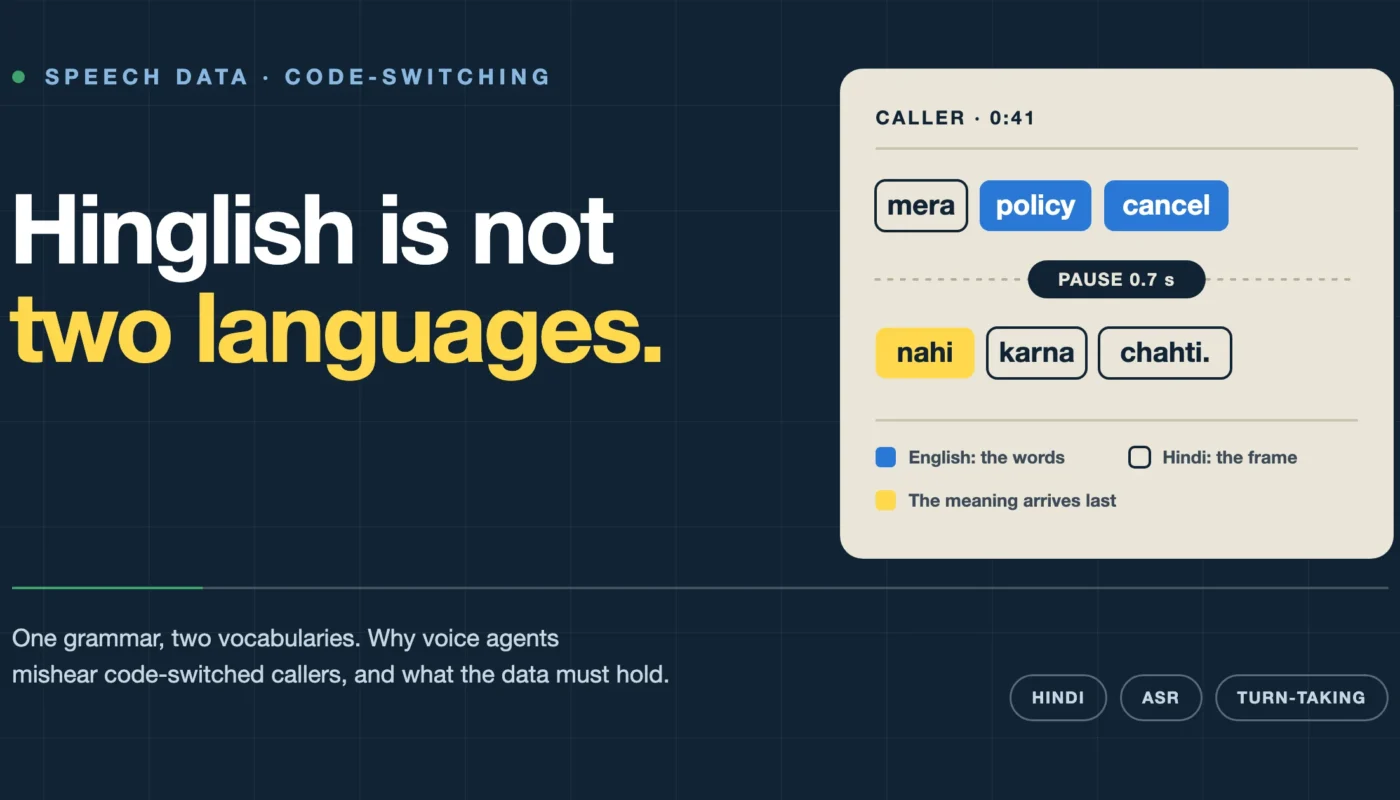
- Most Hinglish is not two languages taking turns. Hindi usually supplies the grammatical frame and English supplies content words, so the words that carry tense, polarity and agency are often the small Hindi ones.
- Word error rate penalises valid script and numeral choices and forgives meaning-changing errors. In a worked 20-word example, three correct transcripts score 20% to 50%, while one with a wrong claim digit scores 5%.
- Published Hindi-English results show the gap: pretrained Whisper large-v2 got 42.9% of Hindi-to-English switch-point bigrams right on the MUCS test set, and transliteration-aware scoring halved Google’s measured voice-search error in one setting.
- Hindi is verb-final, so negation, tense and even what kal means can arrive in the last syllables. A silence rule tuned on English can end the turn before the sentence has said what it means.
It is 7:52 on a Tuesday evening in Lucknow. A woman calls her insurer’s helpline from her kitchen, phone wedged between ear and shoulder, a pressure cooker on the stove behind her.
“Haan ji. Mera claim reject ho gaya tha, CL four two nine eight.” The voice agent finds the claim. Then she says: “Main policy cancel…”
The cooker whistles. She turns down the flame. Seven-tenths of a second pass.
“…nahi karna chahti. Bas status check karna hai.”
By the time she reaches nahi, the agent is already talking. “Sure, I’ll cancel your policy. Can you confirm your date of birth?” She says arre nahi nahi, twice, over the top of it. The call recovers, eventually. The log does not show a crisis. It shows a transcript in which every word is spelled correctly.
The scene is a composite and the timings are illustrative. The pattern is not. The caller used eleven words in that sentence, from two vocabularies, and the agent heard all eleven. The obvious diagnosis is a language gap: collect more Hindi and more Indian English, and the problem goes away.
It does not, because nothing in that sentence was a vocabulary problem.
Start with one sentence and count the languages
The easiest way to see the structure is to slow one sentence down until it can be counted. Take the caller’s first line, written out in full:
haan mera claim reject ho gaya tha, number hai CL four two nine eight, mujhe bas status check karna hai.
There are twenty words. Tag each one by language, as an annotator would. Haan, mera, ho, gaya, tha, hai, mujhe, bas, karna and the second hai are Hindi: ten words. Claim, reject, number, four, two, nine, eight, status and check are English: nine words. CL is a claim prefix that belongs to neither language. The convention is to tag it as language-independent and leave it out of the count.
Linguists have a measure for how mixed a stretch of text is. Amitava Das and Björn Gambäck introduced the Code-Mixing Index in 2014 while building word-level language identifiers for Indian social media. [3] If an utterance has n tokens, u of them language-independent, and wmax words in its most frequent language, then
The index asks one question: if you guessed the dominant language for every word, how often would you be wrong? A monolingual sentence scores 0. A sentence split exactly between two languages scores 50. Ours has n = 20, u = 1 and wmax = 10, so CMI = 100 × (1 − 10/19) = 47.4. It is nearly as mixed as a two-language sentence can be.
CMI ignores order, so a second count helps. Walk the tagged words left to right, skip CL, and mark every place where the language changes. There are eight switch points across nineteen tagged words: 8 of the 18 adjacent pairs, or 0.44. Guzmán and colleagues call that ratio the I-index, “the approximate probability that any given token in the corpus is a switch point.” [5] Real speech mixes less densely than this toy, but not by an order of magnitude. In the Hindi-English test set of the MUCS 2021 challenge, Biswas and colleagues count 9,365 switch points in 37,842 words: one roughly every four words. [9]
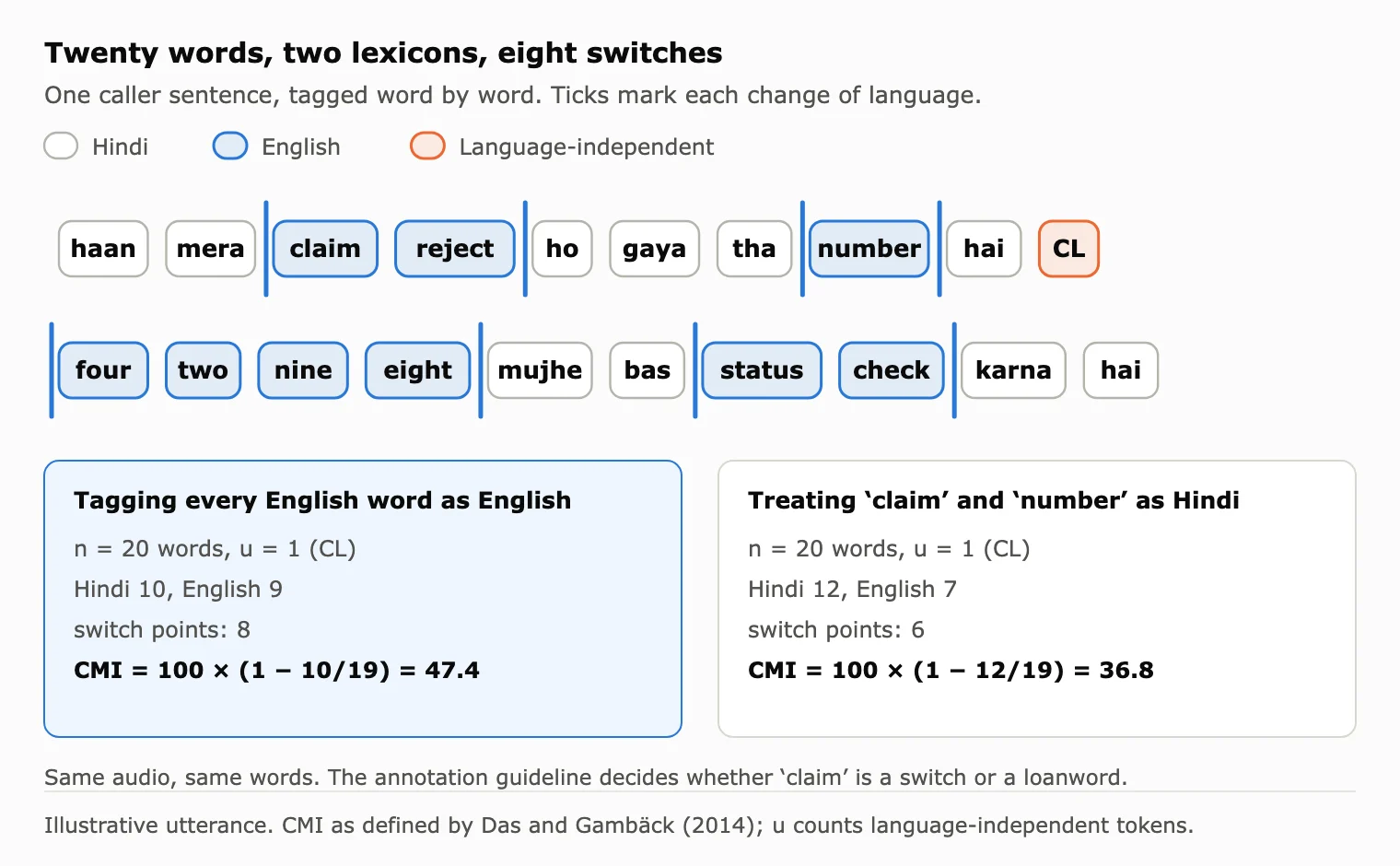
Figure 2 also shows the first trap, and it is not in the audio. Is claim an English word in a Hindi sentence, or a Hindi word that happens to come from English? Many speakers would never say dava for a claim, or sankhya for a number. If the annotation guideline treats claim and number as borrowings, the same recording has six switch points and a CMI of 36.8. Nothing about the speech changed. The ruler did.
That sounds pedantic. It is actually a data-specification decision: the tag decides which script a word should be written in and whether it counts in any metric that targets switches. A dataset that does not publish its borrowing list has not finished describing itself.
The English words carry content. The Hindi words carry the contract.
Now look at where the English words fall. They are nouns and verb stems: claim, reject, status, check, policy, cancel. Every one of them is held in place by Hindi. Reject does not conjugate. Ho gaya tha does the conjugating.
Carol Myers-Scotton gave this pattern a name in 1993: the Matrix Language Frame model. [1] In most intra-sentential switching, one language, the matrix, supplies the morphosyntactic frame: word order and the system morphemes that mark tense, aspect, case and agreement. The other, the embedded language, contributes content words that slot into that frame. Kalika Bali and colleagues annotated English-Hindi Facebook posts this way in 2014. They found English embedded in 23.7% of Hindi-matrix sentences, against 7.2% of English-matrix sentences containing Hindi. On verbs, they were blunt: “Single verb embedding of En words are always of the form V + kar in the data.” [2]
Kar means “do.” Ho means “become.” Hindi borrows an English verb by parking it in front of one of these light verbs and letting the light verb do the grammar. That makes the light verb far more than filler. Compare two sentences that share every English word:
Mera claim reject ho gaya. My claim got rejected. Nobody is named; it happened.
Unhone mera claim reject kar diya. They rejected my claim. Someone did it.
The difference between an event and an accusation lives entirely in ho gaya versus kar diya. A customer-service model that reads only the English content sees the same two words in both.
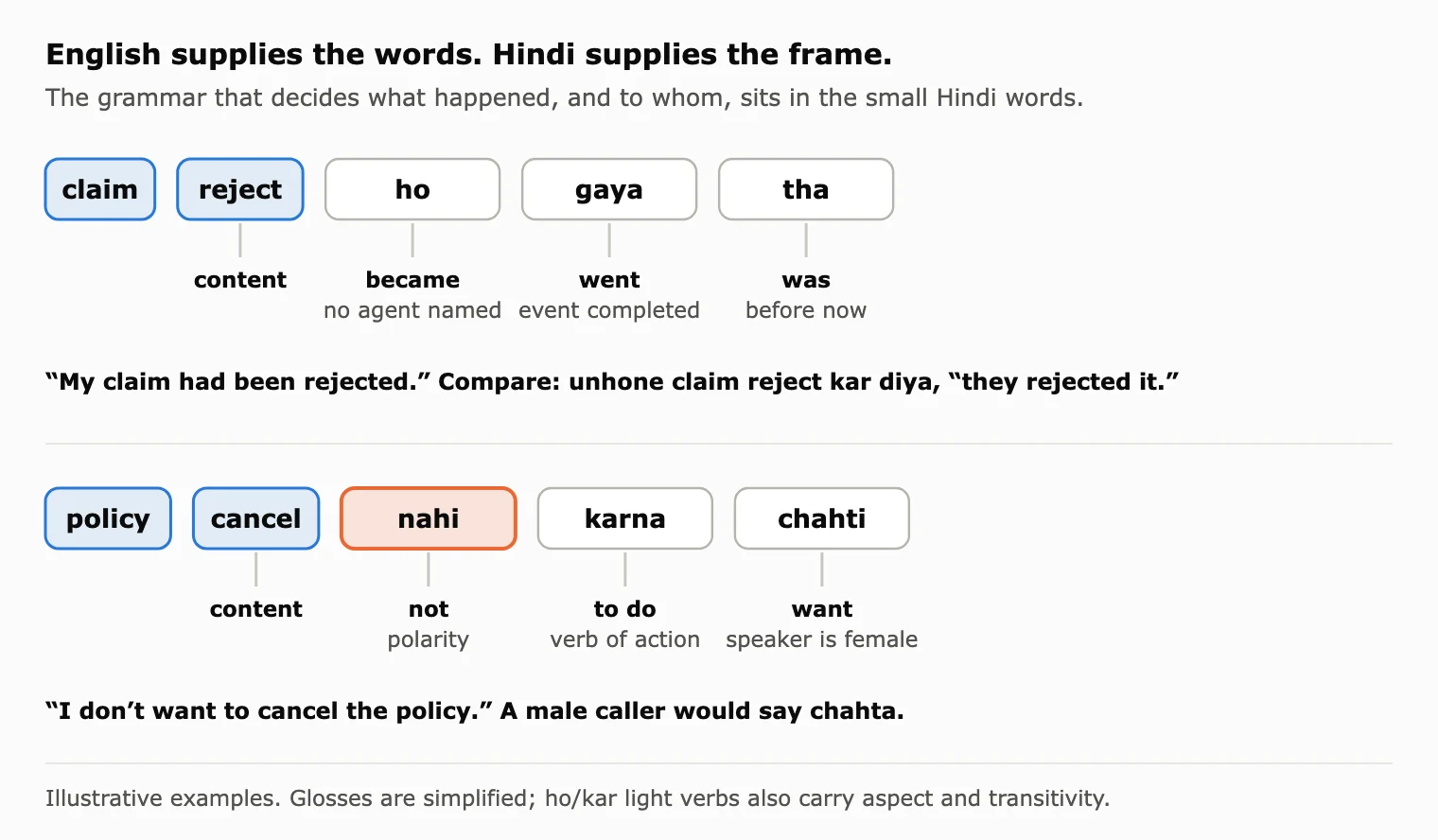
The second sentence in the call is denser still. Policy cancel nahi karna chahti. English supplies the object and the action. Hindi supplies the negation, the verb of doing, the wish, and the speaker’s grammatical gender: chahti is what a woman says; a man would say chahta. Four pieces of meaning, all in Hindi, all after the English word that most systems would treat as the keyword.
A model that has learned English and Hindi separately has learned two lexicons and two grammars. A Hinglish speaker is using one grammar and both lexicons at once. The hard part is the joints.
Two good monolingual models make a strange pair
The tempting engineering answer is a router: identify the language, send each part to the right model, stitch the outputs. A modern version lets one multilingual model pick a language token per segment. Both assume language changes slowly, at segment boundaries. With a switch every four words, any segment-level choice is wrong for a large share of the words, whichever language it picks.
The published numbers show what that costs. Biswas and colleagues at Oracle evaluated Whisper large-v2 on the 5.2-hour MUCS Hindi-English test set. [9] They report that the model “struggles with code-mixed ones, often leading to deletions when a switch to a different language occurs.” Off the shelf, its mixed error rate was 52.0%. They also scored code-switch bigram accuracy: of the word pairs that straddle a switch, how many come out right? For Hindi-to-English switches, 42.9%. For English-to-Hindi, 36.8%. Fewer than half the joints survived.
Fine-tuning on the 89.8 hours of in-domain code-mixed training speech brought the mixed error rate down to 37.4% with a Hindi language prompt and 44.7% with an English one. Their best system, which also used monolingual data and simulated switches, reached 28.8%, with about 76% of switch-point bigrams correct. Even the choice of language token moved the error rate by more than seven points, which is a strange property for a system that is supposed to transcribe one sentence.
MUCS, the most-cited Hindi-English speech benchmark, deserves a caveat. It is recorded computer-science lectures, and its standard test set overlaps the training set by 33.9%. [6] The joints in a support call are different: amounts, dates, refusals, and the small Hindi words wrapped around them.
The same correct transcript can score 50 percent
Suppose the model hears everything. The next problem is that Hinglish has no single right way to be written down.
Hindi is written in Devanagari. English is written in Latin script. Speakers typing on phones often write Hindi in Latin script too, with no standard spelling: mujhe, muje and mujhey are all common. A transcriber can reasonably produce mixed script (Hindi in Devanagari, English in Latin), all Latin, or all Devanagari, with English words transliterated as क्लेम and रिजेक्ट. Numbers can be words or digits.
Word error rate does not know any of this. It counts substitutions S, deletions D and insertions I against a reference of N words:
Score five transcripts of the twenty-word sentence against a mixed-script reference. Write the Hindi in Latin script instead, and each of the ten Hindi words is a substitution: 10/20 = 50%. Write everything in Devanagari, and the nine English words and CL become substitutions: again 50%. Write the claim as 4298 and the four spoken digits become one substitution and three deletions: 4/20 = 20%. Translate the sentence into fluent English and the edit distance is 13 words: 65%.
Now take a transcript in exactly the reference convention that hears five for nine. One substitution: 5%. It is the best score in the set, and the only transcript that sends the agent to the wrong claim.
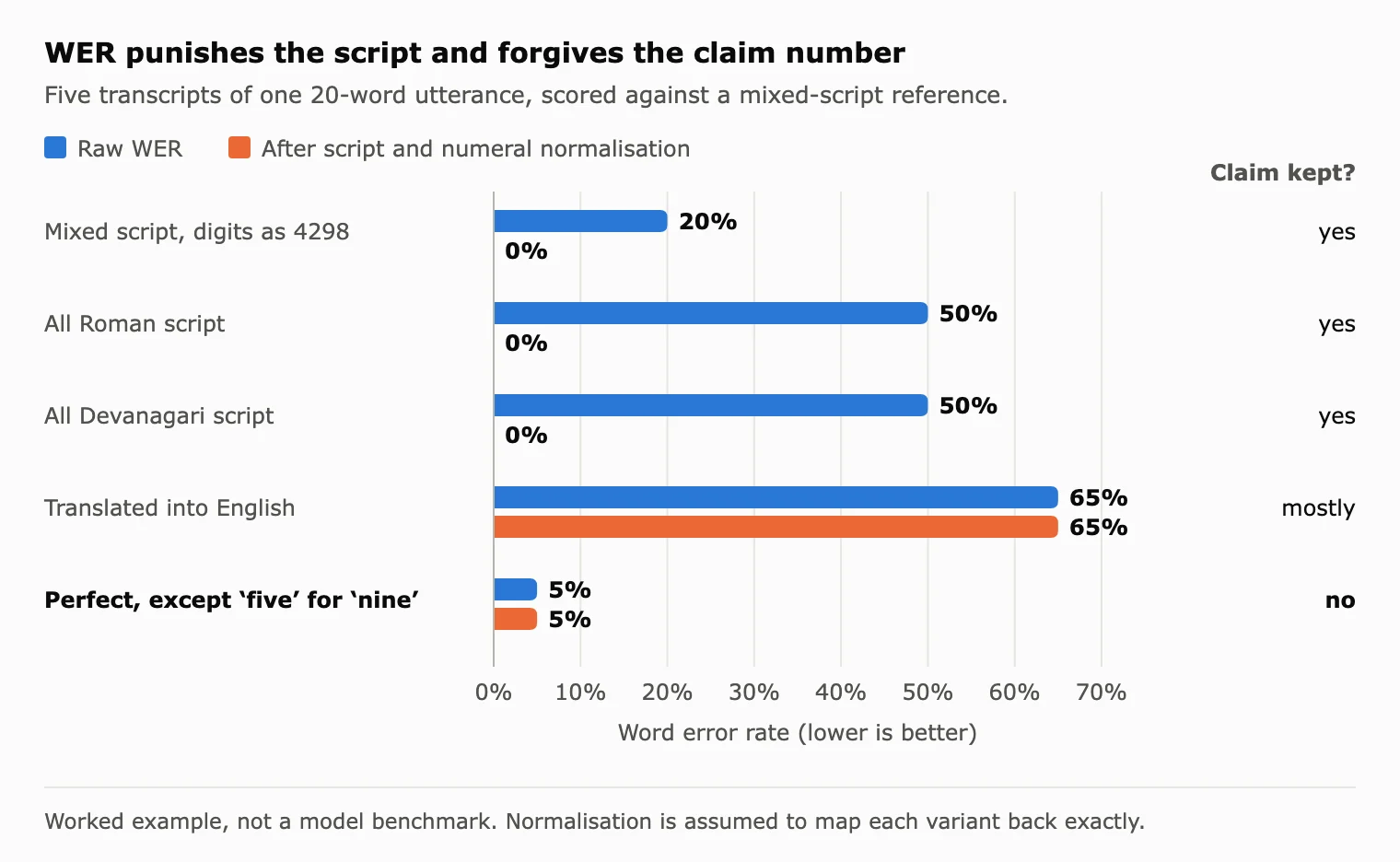
The fix for the first half is well known, which makes it striking how often it is skipped. Google researchers proposed transliteration-optimised WER in 2018: map reference and hypothesis into one script before counting. [7] On Hindi voice search, the baseline system’s WER of 31.5% became 20.6% once script differences stopped counting as errors. For one language model trained on mixed Devanagari and Latin text, conventional WER was 37.0% and the transliteration-optimised figure 17.7%. More than half the measured “error” was spelling. The same paper notes that even bilingual transcribers, told to write English-origin words in Latin script, produced “numerous inconsistencies.” The MUCS organisers ran into the same thing in their own references and introduced a transliterated WER for it. [6]
Newer Indian benchmarks build the ambiguity into the reference. Sarvam’s Indic DiarBench transcribes each session twice, in native script and with English in Latin script and digits, and accepts either. [11] Its evaluation notes give the one-line version: वह doctor के पास गया against वह डॉक्टर के पास गया is 20% WER for a sentence with no error in it. [10]
Normalisation solves the spelling problem. It does nothing for the second half: the five for nine still costs one word in twenty. Ugan, Pham, Bärmann and Waibel make the sharper version of this point with their Point-of-Interest Error Rate, which computes error only on the code-switched words. [8] In one of their Spanish-English experiments, Whisper fine-tuned on speech without switching improved overall WER by 5.06% relative while its error on code-switched words got 39.47% worse. The headline number went up. The joints got worse.
For a voice agent, the words of interest are the claim number, the amount, the date, the nahi: often the shortest, least stressed words in the call, and the ones an aggregate WER is free to lose.
Numbers have their own grammar
Numbers deserve their own section because they fail in every way at once. Many urban Hinglish speakers read out account and claim numbers in English digits, as the caller did. Amounts are another matter. They often come in Hindi, and Hindi counts money with fractions that English does not have.
Nearly every number from 1 to 99 has its own Hindi word, so a model cannot assemble saintaalis (47) from chaar (4) and saat (7). Above that, quantities are built with a small set of fractional prefixes applied to a unit:
Dedh and dhai are 1½ and 2½ on their own. The unit can be sau (hundred), hazaar (thousand), lakh (100,000) or crore (10,000,000), and the written form uses Indian digit grouping.
| Spoken | Literally | Value | Written in India |
|---|---|---|---|
| dedh sau | one and a half hundred | 150 | 150 |
| dhai hazaar | two and a half thousand | 2,500 | 2,500 |
| sava teen sau | three and a quarter hundred | 325 | 325 |
| saadhe chaar hazaar | four and a half thousand | 4,500 | 4,500 |
| paune do lakh | a quarter less than two lakh | 175,000 | 1,75,000 |
| saadhe teen crore | three and a half crore | 35,000,000 | 3,50,00,000 |
Work one through. A caller says paune do lakh. The model catches do lakh and drops the short, unstressed paune. In WER terms that is one deletion in a three-word phrase. In money it is 200,000 against 175,000: an error of 25,000 rupees, 14.3% of the true amount, from one missing word. Drop saadhe from saadhe teen crore and the error is half a crore.
Then the written form has to be chosen: an English normaliser writes 175,000, an Indian bank statement says 1,75,000, and a downstream parser may accept only one. None of this shows up in a WER that normalises numbers away, and most leaderboards do. Perit’s own does, deliberately, so a model is not penalised for writing “2” where the transcriber wrote “two.” That is right for comparing models on words. It means amounts need a separate check.
In a verb-final language, the end of the turn is in the grammar
Back to the pressure cooker, and the part of the call that went wrong.
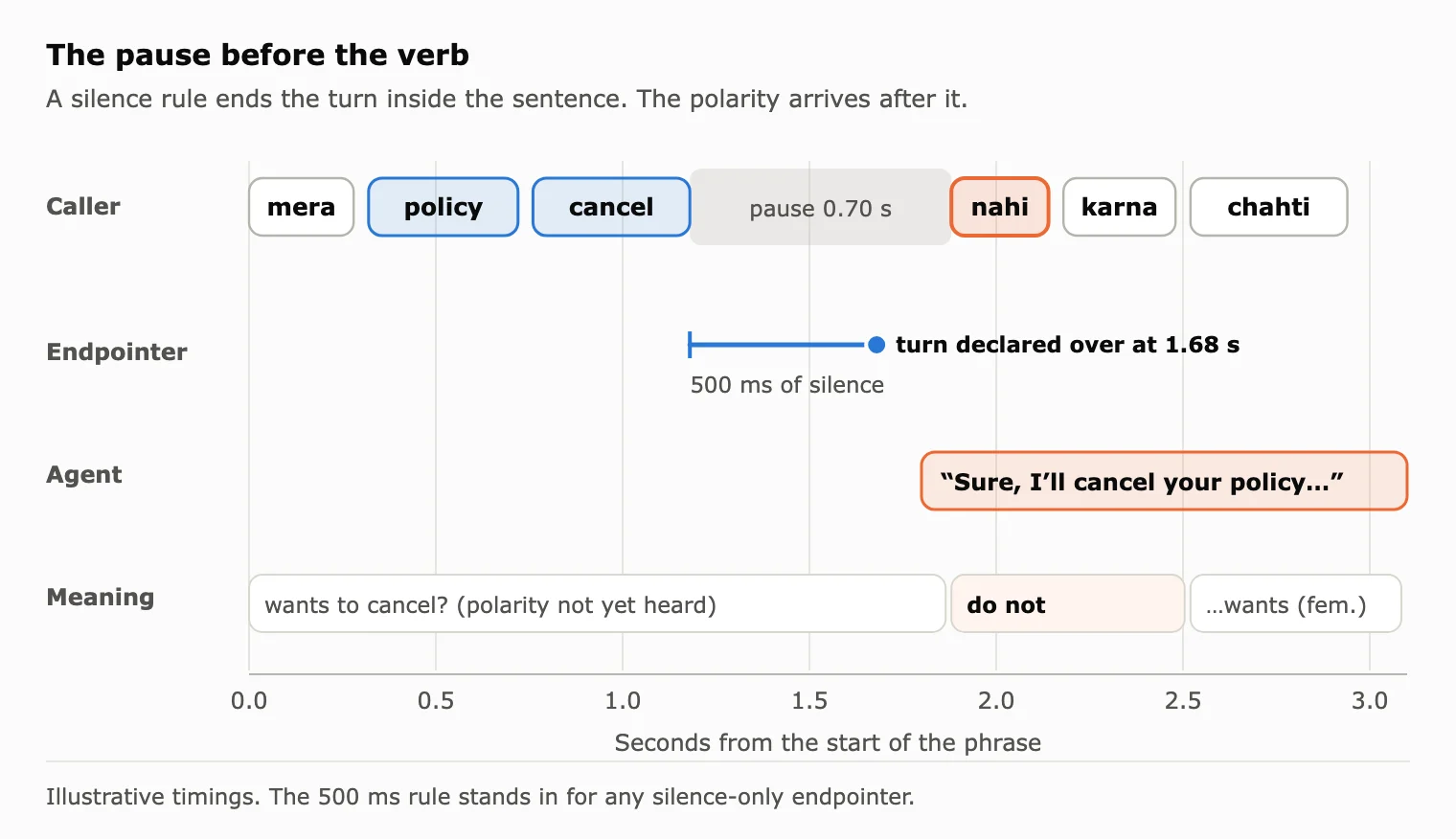
English puts its verb early. “I don’t want to cancel the policy” commits to its polarity at the second word. Hindi is a verb-final language, subject-object-verb in the standard typology, [16] and it puts negation immediately before the verb. Main policy cancel nahi karna chahti. The polarity arrives at word four of six. Until then, everything the listener has heard is compatible with the opposite request.
Time can wait even longer. Kal means both yesterday and tomorrow. Kal payment kar diya is “I paid yesterday.” Kal payment kar dunga is “I will pay tomorrow.” The first three words are identical. The last word decides the tense, and the tense decides what kal meant. An agent that starts acting on kal payment kar… does not yet know whether it is logging a payment or scheduling a reminder.
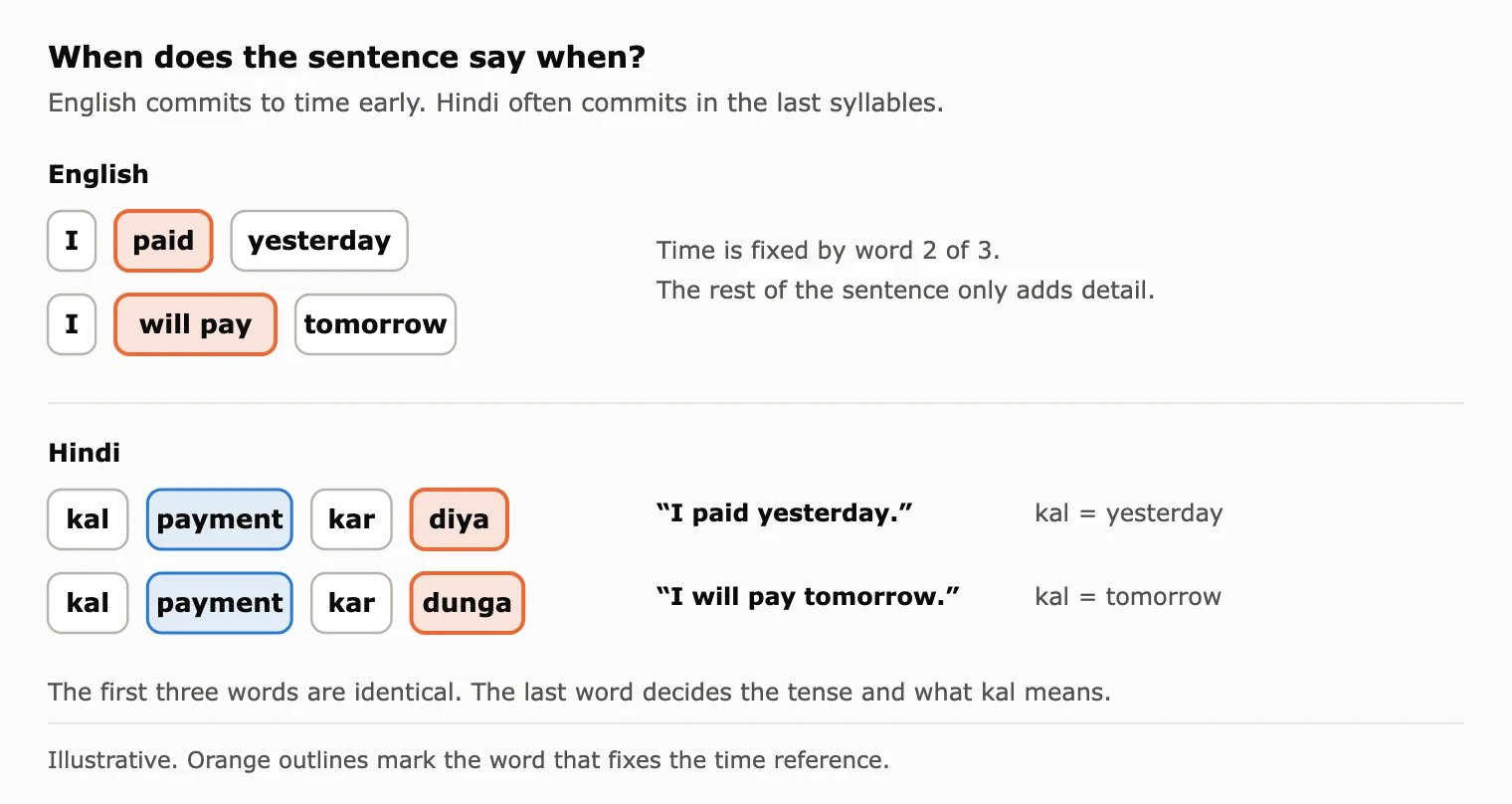
This matters most for turn-taking, the system that decides when the caller has finished. A silence-only endpointer waits for a fixed gap, say 500 milliseconds, then hands the turn to the agent. Speakers do not only pause at the ends of sentences. They pause when they turn down a stove, look for a word, or decide how to phrase a refusal. In a verb-final sentence, a pause before the verb leaves the listener holding the subject and object and nothing else. In Figure 1, the gap after cancel is 0.7 seconds. The endpointer fires at 1.68 seconds. The polarity arrives at 1.88.
Text-based turn detectors read the partial transcript and ask whether the sentence sounds finished. One trained mostly on English has learned that “…cancel my policy” sounds finished. In Hinglish, policy cancel is where the sentence is least finished: the content is in, the grammar that binds it is not.
There is now direct evidence from a language with the same shape. On 30 October, a team working on Turkish, another verb-final language, released TurnTurk-GPT, a text-based turn-taking predictor evaluated on real Turkish conversation. [15] They stripped suffixes from words and measured what the predictor lost. Removing the suffixes of the turn-final word reduced average precision by up to 44%, against 2% for a word inside the sentence, “locating the Turkish end-of-turn cue in verb-final morphology.” When speakers paused, the zero-shot and multilingual baselines they tested stayed close to chance. Synthetic dialogue alone produced the weakest trained model. And their model beat a zero-shot language model only when the test speakers had appeared in training; on unseen speakers, the two were statistically indistinguishable.
Turkish is not Hindi. Turkish stacks suffixes onto the verb; Hindi spreads the work across auxiliaries like hai and light verbs like karna. Whether the Hindi end-of-turn cue sits as heavily in the clause-final verb group is an open question; we found no published end-of-turn evaluation on code-switched Hindi-English. The Turkish result says where to look: the verb group, the pauses just before it, and speakers the model has never heard.
The tempting fix is simply more Hinglish
If the trouble is code-switching, the natural move is to manufacture code-switching. Generate mixed sentences with a language model, synthesise them with text-to-speech, splice monolingual Hindi and English clips together, and train on the result.
It helps, and the size of the help is informative. In the same Oracle study, 22 hours of synthetic code-mixed speech, built from Llama-generated sentences and Indian TTS voices, cut Whisper’s mixed error rate from 52.0% to 40.8%. [9] Splicing monolingual clips at random gave a model trained only on monolingual speech a small gain, from 56.8% to 54.6%. The full real in-domain set, in the best configuration, reached 28.8%. The authors are careful to say that their simulated switching worked best when it was supplemented with some in-domain data. Seductive is not the same as sufficient.
The limits are structural. A spliced clip switches where the clips meet, not where Hindi grammar lets an English word in. A generated sentence carries the generator’s idea of where people switch. TTS voices do not pause before the verb, swallow paune, or call from a kitchen. The Turkish team found the same for turn-taking. What manufactured Hinglish lacks is exactly the frame, and the timing around it.
What a Hinglish dataset has to write down
If Hinglish is one grammar with two lexicons, the dataset has to record the grammar, not only the words. In practice, that means decisions written before collection starts, not discovered in the error analysis.
Fix the script, the spellings and the numbers
Choose the script for each language, publish a romanisation table if Hindi is written in Latin, and decide how digits, amounts and Indian grouping are written. Keep a second reference in the other convention if models will be compared.
Tag every word, and publish the borrowing list
Word-level language tags, a list of English words treated as Hindi loans, and language-independent tags for codes and names. The CMI of the set then means something.
Recruit to a mixing profile, not a language
Quota by CMI band and by speaker background: Hindi-dominant speakers in Lucknow do not mix like English-dominant speakers in Bengaluru. Record on the phones and rooms the agent will hear.
Align words, pauses and turn ends
Word timestamps on both channels, pause durations inside the turn, and labels separating a speaker who has finished from one paused before the verb group.
Mark the words that change the action
Negation, digits, amounts, tense-bearing verb endings and ambiguous time words like kal. Score them separately: exact match on entities and amounts, polarity accuracy, error at switch points.
Keep speakers the model has never heard
Split by speaker, and keep a test set out of every training pipeline. TurnTurk’s gain vanished on unseen speakers; MUCS overlapped train and test by a third.
The better Indian datasets already make some of these choices. IndicVoices elicited code-mixing deliberately in scenarios such as digital payments. [13] Lahaja, a Hindi benchmark spanning 83 districts, found recognition dropping for speakers from North-East and South India, especially on named entities. [14] Who is speaking is part of the specification.
None of these is exotic. Each is a sentence in an annotation guide or a column in a manifest. Together they turn “we have Hindi data” into a set that can tell a team whether its agent will cancel a policy it was asked to keep.
This is the kind of work Perit’s speech bench was built for: hi_IN is one of its nine collection locales, references go through two passes, and alignment is timestamped to the word so a model can be scored on when it heard something as well as what. The point of the list is not the vendor, though. A team building for Indian callers should be able to ask any dataset, its own included, for its script convention, its borrowing list, its CMI distribution and its switch-point error, and get an answer.
What this does not say
It does not say that current models cannot handle Hinglish. Several Indian systems now treat code-mixed output as a first-class mode; Sarvam’s Saaras V4, for example, offers a code-mixed output mode alongside transcription and transliteration. [12] The numbers above come from specific models and test sets, mostly lectures, and newer systems will do better.
It does not say that most Indian speech is code-mixed, or put a number on how much call-centre audio is. We found no published measurement of that share for phone speech, and the text studies, on social media, report mixing in between about a sixth and a quarter of posts or utterances. [2][4]
It does not say that Hindi always supplies the frame. English-matrix Hinglish exists; Bali and colleagues found it far rarer, not absent.
And it does not claim a measured Hindi turn-taking result. The Turkish study is evidence about verb-final morphology in Turkish. The Lucknow call is an illustration. The prediction that Hindi endpointing will fail most often just before the verb group is a hypothesis worth testing on real calls, not a finding.
Back to the pressure cooker
Read the caller’s sentence once more. Main policy cancel… nahi karna chahti.
The English words told the agent what the call was about. A policy, a cancellation. The Hindi words told it what she wanted done about it, and that she was the one who wanted it: not, do, want, feminine, present. They arrived last, after a pause, in the part of the sentence a model trained on two separate languages has the least reason to wait for.
A transcript can hold every word of a Hinglish sentence and still lose the sentence. The words are borrowed from two languages. The meaning is held by one grammar.
The vocabulary says what. The frame says what to do about it.
Sources
- Carol Myers-Scotton, Duelling Languages: Grammatical Structure in Codeswitching, Oxford: Clarendon Press, 1993. Source of the Matrix Language Frame model.
- Kalika Bali, Jatin Sharma, Monojit Choudhury and Yogarshi Vyas, “‘I am borrowing ya mixing?’ An Analysis of English-Hindi Code Mixing in Facebook”, First Workshop on Computational Approaches to Code Switching, EMNLP 2014. 17.2% of posts showed code-mixing; 23.7% of Hindi-matrix vs 7.2% of English-matrix sentences contained embeddings; English single-verb embeddings took the form V + kar.
- Amitava Das and Björn Gambäck, “Identifying Languages at the Word Level in Code-Mixed Indian Social Media Text”, ICON 2014. Code-Mixing Index, Equation 2.
- Björn Gambäck and Amitava Das, “Comparing the Level of Code-Switching in Corpora”, LREC 2016. In an English-Hindi social media corpus, 22.07% of utterances contained switching.
- Gualberto Guzmán, Joseph Ricard, Jacqueline Serigos, Barbara Bullock and Almeida Jacqueline Toribio, “Metrics for Modeling Code-Switching Across Corpora”, Interspeech 2017. M-index and I-index.
- Anuj Diwan et al., “MUCS 2021: Multilingual and Code-Switching ASR Challenges for Low Resource Indian Languages”, Interspeech 2021. Hindi-English: 89.86 h train, 5.18 h test; test set overlaps train by 33.9%; transliterated WER introduced for mixed-script references.
- Jesse Emond, Bhuvana Ramabhadran, Brian Roark, Pedro Moreno and Min Ma, “Transliteration Based Approaches to Improve Code-Switched Speech Recognition Performance”, IEEE SLT 2018. Hindi voice search WER 31.5% vs toWER 20.6%; mixed-script language model 37.0% vs 17.7%.
- Enes Yavuz Ugan, Ngoc-Quan Pham, Leonard Bärmann and Alex Waibel, “PIER: A Novel Metric for Evaluating What Matters in Code-Switching”, ICASSP 2025. Test sets do not include Hindi.
- Astik Biswas, Oleg Shevelev, Amine Abdaoui, Vivek Tyagi and Abdelmoumene Boumadane, “Adapting Whisper for low-resource Hindi-English Code-Mix speech with on-the-fly Augmentation & LLM-Synthesised Data”, Interspeech 2025. Table 1 (switch counts) and Table 2 (MER and code-switch bigram accuracy on the MUCS test set).
- Sarvam AI, “Evaluating Indian Language ASR”, 2 April 2026.
- Sarvam AI and AI4Bharat, “Indic DiarBench”, 11 August 2026; paper at arXiv:2607.23808. Dual-convention references accepted in WER.
- Sarvam AI, “Introducing Saaras V4”, 25 September 2026. Vendor-reported; output modes include transcribe, translate, verbatim, translit and codemix.
- Tahir Javed et al., “IndicVoices: Towards building an Inclusive Multilingual Speech Dataset for Indian Languages”, Findings of ACL 2024. 7,348 hours across 22 languages, with code-mixing deliberately elicited in some scenarios, including digital payments.
- Tahir Javed et al., “LAHAJA: A Robust Multi-accent Benchmark for Evaluating Hindi ASR Systems”, Interspeech 2024. Performance drops for speakers from North-East and South India, especially on named entities.
- Bayrak, Korkmaz, Tuncer and Türkel, “TurnTurk-GPT: Text-Based Turn-Taking Prediction for Turkish”, arXiv:2610.42010, submitted 30 October 2026. Preprint; results author-reported.
- Matthew S. Dryer, “Order of Subject, Object and Verb: Hindi”, World Atlas of Language Structures Online, feature 81A.
Research checked 2 November 2026. The Lucknow call, its timings, the 20-word example and the transcripts in Figure 4 are illustrative and were constructed for this essay; the WER and CMI arithmetic was computed directly and can be reproduced by hand. Published results are author-reported and were not reproduced by Perit. MUCS figures describe lecture speech, not telephone calls. PIER results cited here are for Spanish-English. The Hindi turn-taking argument is a hypothesis informed by a Turkish study, not a measured Hindi result.