The most famous proof in mathematics did not arrive as a paper.
There was no polished theorem at the top of page one, no economical chain of lemmas, no final square drawn beneath an argument that a handful of experts could carry home and read.
There was a four-page note. Beneath it sat fourteen compressed files.
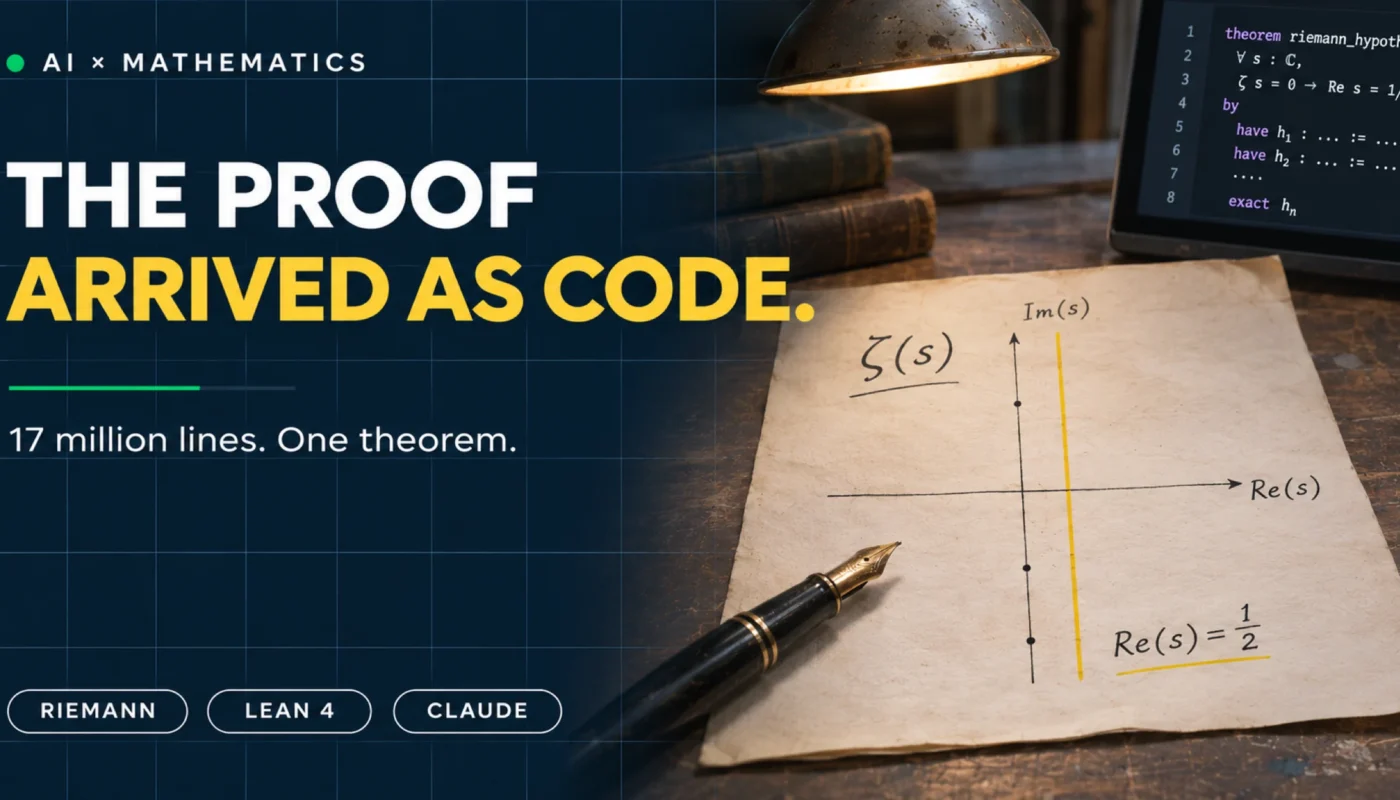
Join those files and a 239-megabyte archive opens into 175,187 Lean modules: approximately 17.4 million lines of formal mathematics, produced by Levent Alpöge and Anthropic’s Claude. The code concludes with a theorem whose type is almost unnervingly short. [1]
theorem riemannHypothesis : RiemannHypothesis := rhOfAllOne line at the summit. Seventeen million lines underneath it.
On 21 November, one day after the release, the Lean FRO and Mathlib Initiative issued a joint statement: the theorem is the standard Riemann Hypothesis already defined in Mathlib; the library compiles; independent comparison tools show that Alpöge’s theorem is exactly that statement; and several independent kernels accept the proof. Their conclusion was unusually direct: they have “full confidence” the proof is correct. [2]
Yet the Clay Mathematics Institute still labels the Riemann Hypothesis active. A human-readable account is a work in progress. Most mathematicians cannot yet explain why the machinery works.
This is not a contradiction. It is the beginning of a new kind of scientific event: correctness can now arrive before understanding.
Did Levent Alpöge and Claude prove the Riemann Hypothesis?
Formally, the available evidence says yes. Lean FRO and the Mathlib Initiative certify that Alpöge’s code proves Mathlib’s standard statement of the Riemann Hypothesis using only Lean’s accepted standard axioms. Independent builds, Lean’s kernel, con-leche, con-ron and third-party kernels have checked the export. Institutionally, the story is not finished. Clay still lists the problem as active, and its prize rules require a qualifying publication, at least two years and general acceptance by the global mathematics community. A conventional human explanation is also incomplete.
Prime numbers keep bad time
The Riemann Hypothesis begins with numbers that refuse to settle into a rhythm.
Prime numbers—2, 3, 5, 7, 11, 13—are the atoms of arithmetic. Every positive integer factors into them, but the primes themselves appear irregularly. Sometimes two arrive close together. Sometimes there is a desert. Their gaps grow and contract without offering a simple clock.
There is an average law. If π(x) counts the primes up to x, the prime number theorem says that π(x) is approximately x / log x. Around one trillion, this approximation gives the broad density correctly. It does not tell where the local surges and shortages will be.
Bernhard Riemann found a stranger instrument for listening to those deviations. For a complex number s with real part greater than one, define the zeta function by an infinite sum:
The same function can be written as a product over primes:
That Euler product is the bridge. A function of a complex variable contains the primes because unique factorisation lets every integer be reconstructed from them.
The zeta function can be continued beyond the region where the original sum converges. It has easy, “trivial” zeros at −2, −4, −6 and so on. Its nontrivial zeros lie in a vertical region called the critical strip, between real parts zero and one.
Riemann’s 1859 conjecture says every one of those nontrivial zeros lies exactly on the centre line:
The imaginary parts may climb indefinitely. The real part, Riemann predicted, never wanders.
Why care about invisible zeros? Explicit formulas turn them into the oscillation around the expected number of primes. Each zero contributes a wave. If all sit on the critical line, those waves are constrained as tightly as number theorists expect. The Clay description puts it cleanly: the prime number theorem gives the average distribution; the Riemann Hypothesis controls the deviation from that average. [5]
A 167-year climb, then six weeks
For more than a century and a half, mathematicians attacked the problem from analysis, geometry, probability, spectral theory and physics. Billions upon billions of zeros have been checked numerically on the line. Numerical confirmation can never reach infinity.
Partial theorems advanced slowly. Hardy proved infinitely many zeros lie on the line. Later work established positive proportions. In August 2026, Alpöge and Ralph Furman reported a dramatic new threshold: at least two-thirds of the nontrivial zeros are simple and lie on the critical line, with a refined constant of 67.25% for their chosen window. The paper says Claude discovered and wrote the argument; its listed authors verified it and took responsibility. [3]
That result did not prove RH. It changed the immediate landscape. Claude was no longer merely manipulating textbook exercises; it had produced a formally verified advance on the exact terrain where the great conjecture lives.
Alpöge’s new note dates the decisive exploration from 6 October to 16 November. The route did not extend the 67.25% calculation one decimal at a time. It tried to import an older proof pattern from a different mathematical world.
The missing multiplicity
One of the few human-scale clues in Alpöge’s announcement begins with Stepanov.
Over finite fields—the arithmetic systems with finitely many elements—there is an analogue of the Riemann Hypothesis for curves. That analogue is a theorem. In 1969, Sergei Stepanov found an elementary route that builds an auxiliary polynomial forced to vanish many times at many points. A nonzero polynomial cannot possess more zeros, counted with multiplicity, than its degree allows. If the construction demands too many, the assumed bad configuration collapses.
The trick needs multiplicity. A zero counted once is a weak constraint; a zero forced to persist through derivatives behaves like many constraints stacked at the same location.
But integers are not a finite-field curve. There is no obvious operation corresponding to repeatedly differentiating a whole number. Stepanov’s engine appears to be missing its transmission.
Alpöge says the new argument replaces that missing multiplicity by chaining theta lifts between unitary groups. A theta lift is a sophisticated way of transporting automorphic information from one group to another. Each link in the chain is made to mimic another unit of multiplicity. For a von Mangoldt prime sum of length X, the proposed chain has length around √X.
Integer route in the new proof · iterated theta lifts imitate multiplicity
Scale proposed by Claude · chain length ≈ √X
Everything after that sentence expands. Alpöge’s four pages name Gan–Gross–Prasad periods, a Rallis seesaw, Bost’s slope inequality, an Iwasawa tower, relative trace formulas, covolumes, congruences and arithmetic divisibility. The breadth matters because it reveals what Claude did not do: it did not stumble upon a three-line algebra trick that generations had overlooked. It coordinated machinery from distant parts of modern number theory at a scale that resists ordinary exposition.
A working guide by Michael Rubinstein now translates the proof’s zeta-function branch toward classical analytic number theory. Its current version is hundreds of pages and explicitly remains incomplete: it reduces the central inequality to thirteen hypotheses drawn from the Lean development rather than proving each one in ordinary prose. [4]
The map is being drawn after the expedition returned.
What Lean checked
Lean is not a mathematical oracle. It is a proof assistant with a small kernel that checks whether each claimed step follows from declared definitions, previous theorems and accepted logical axioms.
Claude could generate a convincing paragraph containing a hidden gap. A Lean proof containing the analogous gap does not earn partial credit. The term fails to typecheck. This is why 17 million lines can be more trustworthy than four fluent pages: the enormous object is not trusted as prose. It is replayed as a certificate.
The independent verification recorded by Waterloo mathematician Michael Rubinstein is unusually concrete. All 175,187 modules compiled. A scan found no sorry, admit, custom axiom or unchecked escape hatch. Lean’s own kernel replay accepted every module. A separately implemented Rust kernel called nanoda checked 1,484,729 declarations used by the five headline theorems with no typechecker error. The theorems depend only on Lean’s three standard axioms: propext, Classical.choice and Quot.sound. [6]
The verification separates four questions that news headlines tend to merge:
The theorem is compared with Mathlib’s independently vetted definition of the Riemann Hypothesis.
Independent machines reproduce the build from the released archive and pinned dependencies.
Axiom audits and source scans look for unfinished goals, extra axioms and kernel bypasses.
Multiple kernels replay the inert proof export, including independently implemented checkers.
The third and fourth steps are essential. A program that merely prints “verified” proves nothing. Confidence comes from a small trusted checker, an inspectable theorem statement, an audited dependency chain and independent replay.
This is the same architectural lesson visible in AlphaProof Code’s verification of Signal. Generative systems can make proof production enormous and cheap; correctness comes from a deterministic gate that does not share their incentives or failure modes.
Correctness is not yet comprehension
A traditional mathematical proof carries two payloads.
The first is certification: the theorem follows. The second is compression: a human mind can see the central reason, reuse the technique and decide which parts are accidental.
The Lean archive appears to deliver the first payload with extraordinary strength. It does not yet deliver the second in a form the field can absorb.
| Layer | Question | Status on 25 November 2026 |
|---|---|---|
| Formal statement | Does the theorem express the standard RH? | Independently compared and certified by Lean/Mathlib groups. |
| Formal validity | Does the proof check without extra assumptions? | Accepted by multiple kernels and independent builds. |
| Mathematical explanation | Can experts survey the route and identify the decisive ideas? | Active work; guides are partial and evolving. |
| Community acceptance | Has the result become settled mathematical knowledge? | Early, although formal verification provides unusually strong evidence. |
| Clay recognition | Has the Millennium Prize process concluded? | No. Clay still lists RH as active. |
This distinction does not demote the proof. It explains why the next phase matters. A massive formal argument can contain a clean idea buried beneath scaffolding, duplicated lemmas and suboptimal constructions. Alpöge himself expects drastic simplification. Deformalisation is not ceremonial translation; it is research.
Mathematicians will ask which theta lifts are essential, whether the √X chain is sharp, where positivity enters, which divisibility estimates carry the real burden and whether the architecture generalises. They will attempt to replace thousands of local moves with one conceptual lemma. A proof becomes a method only when its reusable shape is visible.
Why Clay has not moved the page
The million-dollar prize has its own clock.
Clay does not accept direct submissions. Its published rules say a proposed solution must appear in a qualifying outlet, at least two years must pass, and the work must receive general acceptance in the global mathematics community before the institute will consider it. [7]
A Lean community certificate and a Clay prize answer related but different questions. The first asks whether a formal proof term establishes the stated theorem in a specified logical environment. The second is an institutional process for recognising a complete mathematical solution after publication and community scrutiny.
That difference makes “Clay still says unsolved” a poor rebuttal to the formal checks. It also makes “a kernel accepted it, therefore the prize is won” premature.
The likely next sequence is publication, explanation, simplification, adversarial reading and eventual consensus. Formal verification radically strengthens the starting position. It does not abolish the social process by which mathematics becomes shared knowledge.
This does not suddenly break encryption
Riemann headlines often drift toward claims that internet cryptography will collapse. The conclusion does not follow.
Modern public-key cryptography relies on the practical difficulty of problems such as integer factorisation or discrete logarithms. RH describes the location of zeros of the zeta function and sharpens bounds across number theory. It does not provide an efficient factorisation algorithm, reveal private keys or turn exponential search into a fast computation.
The Generalized Riemann Hypothesis has algorithmic consequences. Under GRH, some number-theoretic searches become provably shorter; bounds for deterministic primality testing, class groups and prime witnesses improve. Many algorithms already state performance theorems conditional on GRH. A proof converts certain conditional guarantees into unconditional ones.
That is important. It is not a cryptographic zero-day.
The enterprise lesson is a proof supply chain
Most enterprises will never need to verify an automorphic representation. They will encounter the organisational pattern much sooner.
An AI system generates an artifact too large for humans to inspect line by line. The artifact may be software, a mathematical derivation, a compliance policy, a database migration or a hardware design. Traditional review collapses under volume. The answer cannot be to trust the model’s confidence.
The Alpöge–Claude release suggests a different architecture:
AI-generated work → arbitrarily large candidate certificate
Small trusted gate → deterministic verification
Independent replay → different implementations, same result
Human distillation → explanation, reuse and governance
The hardest part moves toward the edges. Who defined the theorem? Does the formal statement match the real requirement? Which axioms and libraries are trusted? Can an independent checker replay the result? Can people eventually understand what has been certified?
This is the proof equivalent of software provenance. A familiar title is not enough. The chain from statement to dependencies to certificate to checker has to be inspectable.
The 17 million lines are therefore not merely a spectacle of scale. They are evidence that machine-generated complexity can be governed when it is forced through a narrow, deterministic interface. Enterprises building AI agents should want the same property: models may explore freely, but consequential outputs must cross a gate whose acceptance criteria are explicit and independently testable.
The line at one-half
Return to the critical strip.
For 167 years, mathematicians watched its centre line as if it were a wire stretched through darkness. Every computed zero landed on it. Partial theorems placed more and more of the invisible population there. No finite observation could rule out one fugitive far above the horizon.
Then the proposed proof arrived in a form no single mathematician could read.
The machine did not ask to be believed. It brought a certificate. Other machines replayed it. Independent kernels, written through different routes, reached the same verdict. The theorem at the top matched the theorem the community had written down before the archive existed.
Now humans are walking back through the code, looking for the view.
That reversal may be the lasting story. Mathematics once moved from insight to proof to mechanisation. This result moved from exploration to formal certificate to understanding. The order changed because AI made the middle object too large to narrate and formal verification made it possible to trust before narration was complete.
If the proof survives—and the current machine evidence is unusually strong—the Riemann Hypothesis will not only mark the end of one famous problem.
It will mark the moment a proof stopped being a document and became infrastructure.
Levent Alpöge and Claude’s Riemann Hypothesis proof: FAQ
Who is Levent Alpöge?
Levent Alpöge is a mathematician and member of Anthropic’s technical staff. Before the November 2026 RH release, he co-authored the August 2026 paper proving that more than two-thirds of nontrivial zeta zeros are simple and lie on the critical line, an argument the paper credits to Claude and verifies in Lean.
What did Claude contribute to the Riemann Hypothesis proof?
Alpöge says he guided the search toward a Stepanov-style strategy and the relevant analogue, while Claude supplied much of the technical route near the finish, including the proposed √X-length chain of theta lifts that mimics multiplicity. Claude also helped formalise the argument. The released archive, not the prose note, is the complete proof object.
Has the Riemann Hypothesis officially been solved?
Lean FRO and the Mathlib Initiative certify that the formal proof and theorem statement are correct, and independent kernels have accepted the proof. Clay still lists RH as active because its formal prize process has not concluded. A conventional human-readable proof is also still being developed.
What does 17 million lines of Lean prove?
The archive proves Mathlib’s standard Riemann Hypothesis and additional statements covering the Generalized Riemann Hypothesis for Dirichlet L-functions. Independent audits report no unfinished proofs or nonstandard axioms in the dependency chain of the headline theorems.
Why is a Lean proof trustworthy if Claude generated it?
The generator does not certify itself. Lean’s small kernel checks the proof, and independent checkers can replay an inert export. A hallucinated or invalid step is rejected. Trust still remains in the theorem statement, logical foundations, libraries and checker implementations, which is why independent statement comparison and kernel replay matter.
Does proving the Riemann Hypothesis break RSA or Bitcoin?
No. RH and GRH sharpen many bounds in number theory, but they do not provide an efficient integer-factorisation algorithm or expose cryptographic keys. Some algorithms gain unconditional guarantees that previously assumed GRH; that is different from breaking deployed encryption.
Primary sources and verification records
- Levent Alpöge, announcement note, 20 November 2026. The author’s description of the discovery, claimed scope, Stepanov analogy, √X theta-lift chain and timeline; the attached footnote links the fourteen-part Lean archive.
- Lean FRO and Mathlib Initiative, joint verification statement, 21 November 2026. Certification of the theorem statement, builds, comparison checks and independent proof checking.
- Levent Alpöge and Ralph Furman, “More than two thirds of the zeta zeros are simple and on the critical line”, August 2026. The preceding Claude-discovered, Lean-verified advance and its exact scope.
- Michael Rubinstein, Alpöge/Claude GRH project. Human-readable working guide, verification links and a clear record of what remains to be explained in ordinary mathematics.
- Clay Mathematics Institute, Riemann Hypothesis. Official problem description and current active status.
- Independent Lean verification record, completed 21 November 2026. Reproducible build, axiom audit, kernel replay and nanoda results with hashes, logs and resource measurements.
- Clay Mathematics Institute, Millennium Prize rules. Publication, two-year waiting period and general-acceptance requirements.