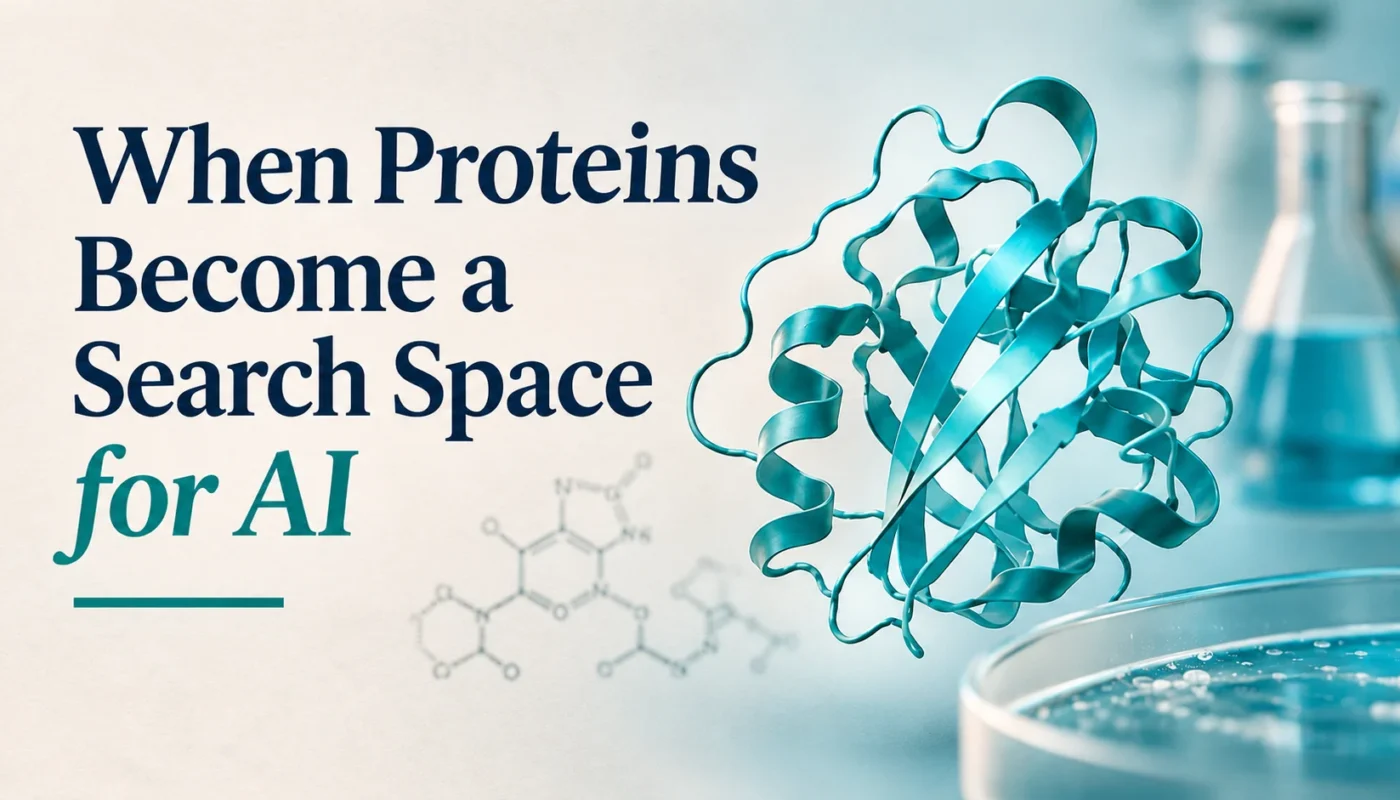
For billions of years, nature has been building proteins. Some carry oxygen through our blood, others help digest food, recognize invading pathogens or transmit signals between cells. Almost every process that keeps a living organism functioning depends on these remarkably versatile molecules. Yet, despite the extraordinary diversity of proteins found across life, there is a much larger possibility that scientists are only beginning to explore: the proteins that have never existed.
A protein begins as a chain of amino acids, but what makes it interesting is what happens next. That chain folds into a three-dimensional structure, interacts with other molecules and eventually performs a particular biological function. A small change in its sequence can sometimes affect how it folds, how stable it remains or what it can interact with. Understanding how these changes translate into biological behaviour has been one of the most persistent challenges in molecular biology.
For a long time, scientists largely worked with what nature had already provided. They studied existing proteins, compared their sequences, determined their structures and modified them to improve particular properties. Computational tools made parts of this process faster, but designing an entirely new protein for a specific purpose remained a difficult problem.
AI is beginning to change that approach. Researchers are developing models that can learn from enormous collections of biological sequences and structures, identify patterns that are difficult to recognise manually and use that knowledge to propose new molecular designs. Some models predict how proteins fold, while others generate sequences or construct entirely new structures based on particular requirements.
The interesting development is not simply that computers can now understand proteins more effectively. They are beginning to help scientists explore possibilities beyond the proteins that evolution has already produced.
The Protein Space Is Far Larger Than Nature’s Catalogue
To understand why this matters, consider how many different proteins could theoretically be constructed. Every protein is made from combinations of approximately 20 standard amino acids. Each has its own chemical characteristics, including size, charge, polarity and interactions with water. Their order within a sequence influences how the resulting protein behaves.
Even a relatively short sequence creates an enormous number of possibilities. A protein containing 100 amino acids can theoretically have 20100 different sequences. That is approximately 1.27 × 10130 possible combinations. Increase the length of the protein, and the number grows exponentially.
20100 ≈ 1.27 × 10130 theoretical sequences.
Of course, not every possible sequence would make a functional protein. Many combinations would fail to fold into stable structures. Others might form structures that aggregate, degrade quickly or simply do nothing useful. Producing a sequence is one challenge; producing a molecule that behaves reliably in a biological environment is an entirely different one.
This distinction is important because the goal of protein design is not to create the largest possible collection of unfamiliar sequences. It is to identify sequences that can fold into useful structures and perform specific tasks.
Nature has already explored an enormous number of these possibilities through evolution. Over generations, mutations introduce variations, while environmental pressures influence which biological traits survive. The proteins found in living organisms are therefore the result of an extraordinary process of molecular experimentation.
But evolution does not search every possible sequence. It works through existing biological systems, building upon what came before. A new protein must also be compatible with the organism in which it develops and function well enough to provide some evolutionary advantage.
This means that naturally occurring proteins, valuable as they are, represent only a small part of the theoretical sequence space. There may be other sequences capable of performing useful functions that evolution simply never had a reason or opportunity to produce.
For scientists, this raises an interesting possibility. What if computational models could use the information contained in existing proteins to explore some of these less familiar regions?
That is the larger opportunity behind generative protein AI. Rather than treating nature’s existing proteins as a complete catalogue of possible biological solutions, researchers can begin using them as a foundation for discovering new ones.
AI Learned to Read the Language of Proteins
One of the developments that made this possible was the emergence of protein language models.
The underlying idea is easier to understand than it might initially sound. Amino-acid sequences contain patterns, and those patterns carry information about how proteins are likely to behave. Looking at an individual amino acid tells us relatively little. Its significance often depends on the amino acids surrounding it and on other parts of the sequence.
There is an interesting parallel with human language. A word can have different meanings depending on the sentence in which it appears. Similarly, an amino acid’s role within a protein depends on its molecular surroundings and its relationships with other positions in the sequence. Proteins are not languages in the human sense, of course, but their sequences contain relationships that machine learning models can learn to recognise.
Protein language models are trained on large collections of naturally occurring protein sequences. Many use transformer-based architectures, which allow them to learn relationships between different positions in a sequence, including positions that may be far apart. [2]
During training, a model learns to recognise which amino-acid combinations are common, which are unusual and how different sequence patterns relate to one another. These relationships can provide clues about protein families, evolutionary constraints and structural properties.
An important part of this process is the creation of numerical representations called embeddings. Instead of treating each amino acid as an isolated symbol, the model converts sequence information into numerical representations that capture its context. Researchers can then use these representations for tasks such as predicting structural properties, identifying protein families and studying the effects of mutations.
The Evolutionary Scale Modeling family, better known as ESM, is an important example of this approach. Its models demonstrated how large-scale learning from protein sequences could reveal useful biological information, including structural relationships, without requiring every protein to be experimentally characterised. [2]
But a protein is much more than its sequence. It folds into a three-dimensional structure, and that structure determines how different regions interact, where molecules can bind and which chemical reactions may be possible. Understanding a sequence without considering its structure leaves a significant part of the biological picture unexplored.
This is why researchers have started developing models that work across multiple forms of protein information.
ESM3 is a particularly interesting example. Introduced as a multimodal generative protein language model, it works across three important biological representations: sequence, structure and function. [1] Rather than learning only from amino-acid strings, it can reason across these different forms of information and generate or complete biological representations under specified conditions.
That is a meaningful shift in how protein models are being developed. Instead of treating sequence, structure and function as separate problems, researchers are beginning to build systems that connect them.
From Predicting Proteins to Generating Them
For many years, one of the biggest challenges in protein research was figuring out how a sequence of amino acids folds into a three-dimensional structure. Scientists could determine structures experimentally, but the process could be time-consuming and technically demanding.
Computational prediction offered another way forward. The introduction of AlphaFold 2 in 2021 was a major breakthrough because it demonstrated how deep learning could predict protein structures with remarkable accuracy across a wide range of targets. [3]
AlphaFold 3 extended this work considerably. Published in Nature in 2024, it introduced a diffusion-based architecture capable of predicting complex molecular structures involving proteins, DNA, RNA, small molecules, ions and modified residues. [4]
Why is this important? Because proteins rarely operate alone. They interact with other molecules to carry out biological processes. Understanding these interactions can help researchers investigate cellular mechanisms, study disease-related molecular activity and identify potential targets for drug development.
However, predicting an existing protein and designing a new one are two very different challenges.
Imagine giving a model an amino-acid sequence and asking it to predict the resulting structure. Now consider a different question: can a model design a new protein that binds to a particular molecular target?
The first task involves understanding something that already exists. The second requires the model to explore possible molecular arrangements and construct a candidate that could satisfy a desired objective.
This is where generative models, particularly diffusion-based approaches, have attracted attention.
Diffusion models became widely recognised through image generation. They learn to transform noisy inputs into coherent outputs through a series of iterative refinement steps. Protein structures are considerably more complicated than images, however. A generated structure must follow geometric and chemical constraints, and its eventual amino-acid sequence must be capable of forming that structure.
RFdiffusion, developed by researchers at the University of Washington and published in Nature in 2023, brought this approach into protein design. It uses a diffusion-based process to generate protein backbones by progressively refining noisy structural representations. [5]
The researchers demonstrated that RFdiffusion could generate new protein monomers, symmetric assemblies and protein binders under specified structural constraints. More importantly, the work did not stop at computational predictions. Hundreds of designed proteins were experimentally characterised, and a designed protein binder was validated in a complex with its target using cryo-electron microscopy.
That is what makes the development particularly significant. AI-generated structures were no longer just interesting predictions on a computer screen. They could become actual molecular candidates that researchers could produce, examine and test in the laboratory.
The process is still far from automatic, but the direction is becoming clearer. Scientists can now begin with a biological objective, define the constraints a protein must satisfy and use generative systems to explore possible designs.
The Search Space Starts to Open
Generating a new protein sequence is relatively easy compared with generating one that actually works. A random sequence may be completely different from anything found in nature, but that does not make it biologically useful.
The real achievement would be to generate something that is sufficiently different from known proteins while retaining the ability to fold and perform a measurable function.
A particularly interesting demonstration came from ESM3. In a study published in Science in 2025, researchers used the model to generate fluorescent proteins. Among the candidates that were synthesised and experimentally tested, they identified a fluorescent protein with only 58% sequence identity to the closest known fluorescent protein.
The researchers estimated that this degree of evolutionary divergence was comparable to approximately 500 million years of evolutionary distance. [1]
| 0% | 20% | 40% | 60% | 80% | 100% |
It is worth understanding what this result actually means. It does not suggest that AI recreated half a billion years of evolution, nor does it mean that scientists can now generate any biological function on demand. What it demonstrates is that a model trained on evolutionary information can produce a protein with measurable function despite substantial differences from known biological examples.
Fluorescent proteins are especially useful for such experiments because their activity can be observed and measured. Under appropriate conditions, they emit light, giving researchers a practical way to test whether a newly designed protein has retained the intended property.
This distinction between computational novelty and biological function is crucial. A sequence may look completely unfamiliar in a database, but its scientific value depends on what happens when it is actually produced and tested.
The ESM3 result also tells us something interesting about what these models may be learning. They are not necessarily copying an existing protein to produce a new one. Instead, they can use relationships learned across biological sequences to generate different combinations that still satisfy important molecular constraints.
In that sense, the model is learning more than a catalogue of proteins. It is learning patterns that help explain what makes certain proteins possible.
How far can this approach go? That remains an open research question. Performance depends on the model, the protein family, the intended function and the quality of the available biological and experimental information. Nevertheless, experimentally validated results suggest that useful protein designs do not always need to remain close to naturally occurring sequences.
For protein science, that is a significant change in perspective. The search space is no longer limited to finding variations of molecules that evolution has already explored.
Designing a Protein Around a Job
Traditionally, protein engineering often begins with an existing molecule. Researchers identify a protein with a useful property and then modify its sequence to improve stability, activity, specificity or some other characteristic.
Generative protein design introduces a different starting point. Instead of asking what an existing protein can do, researchers can begin by describing what they want a protein to accomplish.
This approach is closely related to a concept known as inverse design. In conventional biological understanding, the relationship is often described as sequence leading to structure, which in turn influences function. In inverse design, researchers start with a desired function and work backwards to identify a suitable structure and sequence.
S = candidate amino-acid sequence
X = predicted three-dimensional structure
F(S) = predicted function of the sequence
Ftarget = desired biological function
L = difference between predicted and desired function
arg min = the sequence that minimises this difference
| Design Aspect | Conventional Engineering | AI-Assisted Inverse Design |
|---|---|---|
| Starting point | An existing protein | A desired biological function or property |
| Main approach | Modify existing sequences through mutation and optimisation | Explore candidate structures and sequences using generative models |
| Search strategy | Often explores variations around known proteins | Can explore designs beyond close natural sequence matches |
| Computational role | Supports mutation analysis and optimisation | Can generate structural and sequence candidates under constraints |
| Experimental role | Tests and refines modified proteins | Tests generated candidates and guides further design iterations |
| Sequence | → | Structure |
| Structure | → | Sequence |
Consider a researcher trying to design a protein that binds to a particular region of a disease-associated molecule. The objective is not simply to generate a protein with a plausible three-dimensional shape. The candidate must have an appropriate interaction surface, fit the target’s geometry and form sufficiently strong and specific molecular interactions.
A generative model can help explore possible structural arrangements. Sequence-design systems can then identify amino-acid combinations that may form those structures. Prediction models can assess whether the resulting sequences are likely to adopt the intended configurations. [6]
Researchers are increasingly combining these capabilities into connected workflows rather than relying on a single model to solve every part of the problem.
RFdiffusion demonstrated the potential of this approach through its protein-binder experiments. Researchers generated candidate binders against several protein targets, including influenza haemagglutinin. The resulting designs were then evaluated experimentally, demonstrating that computationally generated structures could lead to functional molecular interactions. [5]
The possibilities extend well beyond protein binding. Similar approaches could support the development of enzymes with particular catalytic properties, proteins that assemble into controlled structures and molecules designed to recognise specific biological targets.
This could eventually change how researchers approach molecular engineering. Rather than starting exclusively with an existing biological molecule and trying to improve it, scientists could begin with a desired property and computationally explore structures and sequences that might deliver it.
There is, however, an important limitation. A protein’s behaviour depends not only on its sequence and structure but also on its environment, molecular partners and surrounding biological conditions. A design that looks promising computationally may behave very differently when introduced into a real biological system.
Inverse design therefore provides a way to explore possibilities, not a guarantee that the intended biological outcome will follow.
The Laboratory Is Still the Final Filter
Generating thousands of protein candidates sounds impressive, but the difficult part begins when those candidates have to work outside a computational model.
A sequence may look promising in a prediction, yet fail to fold into the intended structure when produced experimentally. Another may fold correctly but prove unstable under ordinary laboratory conditions. Some proteins aggregate, degrade or become difficult to express in the biological systems used to produce them.
Stability is particularly important. A protein might perform well under carefully controlled conditions but lose its structure when exposed to changes in temperature, pH or chemical environment. For applications in medicine, biotechnology or industrial processes, these limitations can determine whether a design is practically useful.
Expression introduces another challenge. Researchers must be able to produce the designed protein in sufficient quantities using an appropriate biological or laboratory system. A theoretically successful design has limited value if it cannot be produced reliably.
Then comes the most important question: does the protein actually perform the task it was designed for?
A binder must bind its intended target. An enzyme must catalyse the desired reaction. A fluorescent protein must produce measurable fluorescence. Researchers also need to investigate specificity, because a molecule that interacts with its intended target may still interact with other molecules in undesirable ways.
This is why experimental validation remains central to modern protein design. Computational models help narrow down the enormous search space, but laboratory experiments determine which candidates are genuinely useful.
The process is increasingly becoming iterative. Models generate candidates, computational screening filters them, experiments test the strongest designs and the resulting observations can guide further improvements. Each stage provides information that can make the next round more effective.
There are also questions of biological safety and responsible research. Proteins are active molecules, and changing their properties can have consequences that are difficult to anticipate from computational predictions alone. As generative systems become more capable, appropriate screening, experimental oversight and safeguards will remain essential.
The laboratory, therefore, is not merely the place where an AI-generated prediction receives its final approval. It is an essential part of the discovery process, helping scientists distinguish a plausible molecular design from one that genuinely works.
The Beginning of a Different Kind of Protein Science
For much of modern molecular biology, researchers have been trying to understand the proteins that nature has already produced. They have investigated their structures, studied their functions and explored how small changes in their sequences influence biological behaviour.
AI is beginning to expand that objective.
Protein language models can learn from evolutionary information. Structure-prediction systems can make complex molecular arrangements easier to investigate. Generative models can propose sequences and structures that researchers might never have considered through conventional approaches.
These developments are not interchangeable, and no single system has solved the entire problem of protein design. Predicting a structure, generating a stable sequence and producing a molecule with a reliable biological function remain separate scientific challenges. But the growing ability to connect these capabilities is changing how researchers approach molecular discovery.
Perhaps the most interesting part is not simply that AI can generate a new protein. It is that scientists can increasingly begin with a biological objective and use computational systems to explore molecular solutions that would otherwise be difficult to imagine, construct or test.
Nature’s proteins remain the foundation of this work. They represent billions of years of evolutionary experimentation, and the information contained within them is what makes modern protein AI possible. But that information no longer has to serve only as a record of existing biological solutions. It can also become a starting point for exploring new ones.
The question is gradually changing from how many proteins nature has produced to how many useful proteins science has yet to discover.
And researchers are now developing tools that can begin to search for an answer.