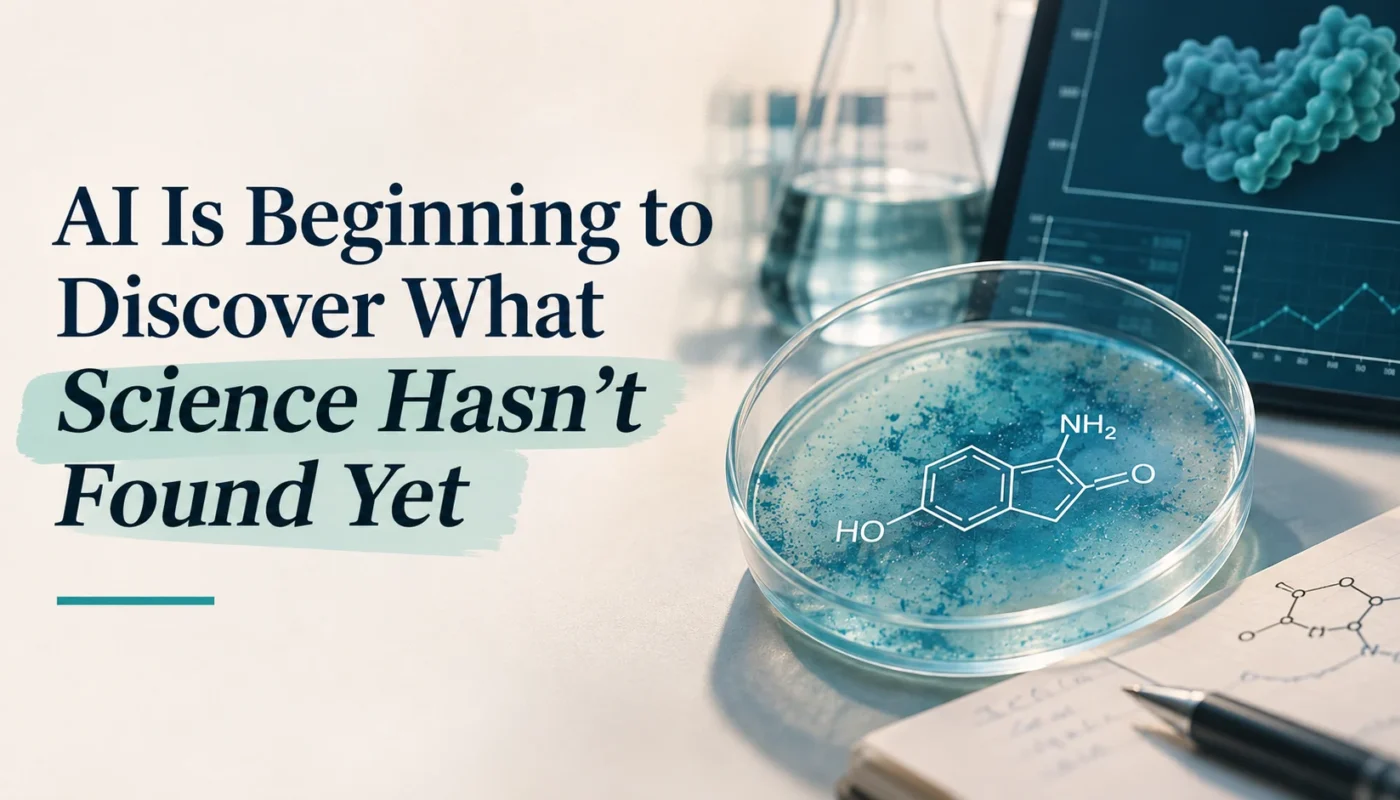
Artificial intelligence is moving beyond predicting outcomes and analyzing existing research. It is beginning to help scientists formulate new hypotheses, connect overlooked findings and explore questions that were once difficult to investigate.
The hardest part of science may be finding the right question
Scientific discovery is often presented as a straightforward process: researchers observe a phenomenon, develop a hypothesis, design an experiment and analyze the results. In reality, much of the difficult work happens before an experiment even begins. Researchers may spend months examining previous studies, comparing findings and searching for connections that could lead to a new explanation.
This challenge is becoming more noticeable as scientific information continues to grow. Millions of research papers, expanding biological databases and increasingly complex experimental datasets produce more information than individual researchers can realistically examine. Even within a specialized field, keeping up with every relevant development is difficult. Finding connections between different disciplines can be harder still.
Artificial intelligence has already made it easier to search and organize this growing body of knowledge. However, a more interesting development is emerging: systems that use existing scientific evidence to propose explanations that researchers can investigate experimentally. Instead of simply answering questions about what is already known, these systems are beginning to help identify what might be worth discovering next.
The difference is significant. Explaining an established scientific concept is very different from identifying an unexplored relationship, developing a possible explanation and suggesting how it could be tested. The latter requires working with incomplete evidence, considering competing possibilities and recognizing where further investigation might produce useful results.
From predicting answers to exploring possibilities
Much of the earlier progress in AI-driven science came from prediction. Researchers trained models on large collections of scientific data, allowing them to recognize patterns and estimate properties that would otherwise require extensive calculations or experiments. In biology, models learned to predict protein structures and molecular interactions. In chemistry, machine learning helped estimate molecular properties, while similar techniques improved the analysis of complex systems in physics and climate science.
These applications are valuable, but prediction and discovery are not necessarily the same thing. A predictive model generally learns relationships from available examples and uses them to estimate an unknown outcome. Scientific discovery often requires researchers to go further by identifying possibilities that have not yet been explored.
Consider a researcher studying a disease who already knows that a particular biological pathway is involved. A predictive system might estimate how a known compound interacts with that pathway. A discovery-oriented system would attempt to identify other mechanisms or compounds that could influence the disease, including connections that are not immediately obvious from existing research.
This changes the problem from estimating an outcome to exploring a much larger space of possible explanations. AI-assisted hypothesis generation aims to make this exploration more manageable by producing candidate explanations, comparing them against available evidence and helping researchers prioritize questions for further testing. The objective is not to eliminate uncertainty but to make it easier to investigate.
AI’s growing contribution to science may not be its ability to provide faster answers, but its ability to help researchers investigate questions they might never have thought to ask.
The hypothesis is becoming a computational object
Traditionally, developing a scientific hypothesis has depended heavily on a researcher’s subject knowledge, familiarity with previous studies and ability to recognize patterns across observations. AI systems are beginning to extend this process by generating and evaluating multiple hypotheses systematically.
A hypothesis can now be treated as something a computational system can produce, compare against alternatives, examine for supporting evidence and revise as new information becomes available. Rather than generating one explanation and stopping there, a system can explore competing possibilities, identify weaknesses and prioritize promising research directions.
This approach is reflected in Google’s AI Co-Scientist, described in a 2026 Nature publication. The system uses multiple specialized AI agents that work together to generate, critique and refine research hypotheses. [1] Instead of relying on a single response from a language model, it uses an iterative process in which different agents examine competing ideas and help determine which directions deserve further attention.
Its architecture draws on an important part of scientific research: the evaluation of competing explanations. Scientists rarely accept an initial hypothesis without questioning it. They compare it with previous findings, consider alternative mechanisms and look for evidence that might contradict their assumptions. AI Co-Scientist attempts to organize parts of this process computationally, allowing hypotheses to undergo repeated evaluation rather than being accepted simply because they sound convincing.
The contribution is not that an AI system independently understands a scientific problem in the same way an experienced researcher does. Its value lies in exploring numerous possibilities, retrieving relevant information and examining different lines of reasoning relatively quickly.
When AI proposes something researchers can actually test
The value of hypothesis generation becomes clearer when an AI-generated idea moves beyond a computer screen and is tested in a laboratory. One particularly interesting example comes from a 2026 study published in Nature, which introduced Robin, a multi-agent AI system designed to connect scientific literature analysis, hypothesis generation and experimental investigation. [2]
Robin uses specialized agents to examine scientific literature, explore biological mechanisms, generate therapeutic hypotheses and identify candidates for experimental testing. Importantly, its work does not end when the system produces a suggestion. Experimental findings can be returned to the system and used to guide subsequent rounds of hypothesis generation.
In an investigation involving dry age-related macular degeneration, Robin identified potential therapeutic compounds, including ripasudil, a drug already approved for treating glaucoma. The system proposed investigating its potential through a mechanism involving increased phagocytosis in retinal pigment epithelial cells. Researchers subsequently conducted laboratory experiments and reported evidence supporting the proposed effect in their experimental model. [3]
1.0× = DMSO control
Read the research paper.
What makes this example interesting is not simply that an existing drug was suggested for another condition. Drug repurposing has been studied for years. The more interesting contribution was the way Robin connected findings from different areas of scientific literature to generate a testable biological hypothesis and then incorporated experimental results into its reasoning process.
The real opportunity lies in connecting scientific findings that already exist but have never been examined together. AI can help turn those overlooked relationships into questions that researchers can investigate.
Scientific knowledge is often distributed across separate research communities. A finding in one area may have implications for another, but those connections are not always obvious to researchers working within specialized fields. AI systems can examine a broader collection of scientific information and identify relationships that might otherwise remain overlooked.
However, identifying a possible connection is only the beginning. A computational suggestion must still be evaluated through appropriate experiments, and results obtained in a laboratory model do not automatically establish clinical effectiveness. The value lies in demonstrating how AI-generated hypotheses can direct experimental research, not in treating a computational prediction as a confirmed medical treatment.
| Research area | Google Co-Scientist | FutureHouse Robin |
|---|---|---|
| Developer | Google DeepMind and Google Research | FutureHouse |
| Core approach | Multi-agent hypothesis generation, critique and refinement | Multi-agent hypothesis generation and experimental data analysis |
| Key mechanism | Generation, reflection, ranking and evolution of ideas | Literature search, experiment proposals and analysis of experimental results |
| Research focus | Biomedical research problems across multiple areas | Experimental biology and therapeutic discovery |
| Demonstrated application | Drug repurposing, target discovery and antimicrobial resistance research | Identifying ripasudil and KL001 as candidates for enhancing retinal cell phagocytosis |
| Validation | Expert-in-the-loop evaluations and laboratory experiments | Iterative laboratory testing and experimental data feedback |
Why exploring unfamiliar connections matters
One of the more interesting aspects of AI-assisted discovery is its ability to examine relationships across different scientific disciplines. Researchers develop deep expertise through years of studying particular subjects, but specialization can make it difficult to continuously follow developments in distant areas of research. A scientist investigating a neurological condition, for example, may not routinely examine every relevant development in immunology or computational chemistry.
AI systems can help bridge these information gaps by searching across large collections of research and identifying relationships between concepts that may not traditionally be studied together. This does not mean AI is automatically more creative than human researchers. Generating an unfamiliar combination of existing ideas is not the same as understanding whether that combination represents a meaningful scientific possibility.
Current generative systems still face limitations involving originality, reliability and their tendency to reproduce familiar patterns from existing knowledge. [4] A model may produce an explanation that appears convincing while overlooking contradictory evidence or relying on an incorrect assumption.
Nevertheless, exploring a large number of possible connections can be useful when combined with scientific judgment. An AI system could examine related findings from different fields, identify additional mechanisms and propose alternative explanations for an observed result. Many suggestions may be irrelevant, but a few could provide worthwhile starting points for further investigation.
The advantage, therefore, is not that AI has replaced scientific intuition. It is that researchers can use computational systems to explore possibilities beyond the limited set they might initially consider.
The real challenge is generating a good hypothesis
There is an important difference between producing a large number of hypotheses and producing hypotheses that are scientifically useful. Language models are particularly good at generating explanations that sound coherent, but scientific research requires much stronger standards. A hypothesis must be sufficiently novel to justify investigation, consistent with relevant evidence and specific enough to be tested. [4]
An idea that is interesting but cannot be translated into an experiment offers limited practical value. Similarly, a hypothesis may appear plausible until researchers examine the underlying data and discover that its central assumption is incorrect. Without reliable verification, AI-generated suggestions can introduce additional work rather than reduce it.
This is why research is shifting towards systems that combine hypothesis generation with evaluation and experimental feedback. Rather than measuring success by how many ideas a model can produce, researchers need to determine whether those ideas can withstand closer examination.
AI Co-Scientist addresses part of this challenge through its multi-agent evaluation process, while Robin connects computational reasoning with laboratory investigation and incorporates experimental findings into subsequent research directions. Both approaches illustrate why evaluation is becoming just as important as generation.
The next generation of useful systems will need to help researchers distinguish between ideas that are merely possible and those worth spending scientific resources to investigate. That requires reliable literature, specialized scientific knowledge, appropriate simulations and, ultimately, experimental validation.
From the literature to the laboratory
The direction in which these systems are developing points towards a more connected scientific workflow. Instead of treating literature review, hypothesis development, experimental design and result analysis as separate activities, AI could help connect them into a continuous process. [4]
A system might begin by examining existing research and identifying a gap in the available evidence. It could then generate several explanations, compare them against previous findings and suggest experiments that would help distinguish between competing hypotheses. Once researchers conduct those experiments, the results could be used to revise the original explanations and identify new questions.
This approach is often described as a closed-loop scientific discovery process. Its defining feature is the movement of information between computational systems and real experiments. The model does not simply produce an answer and stop. It receives new evidence, adjusts its reasoning and helps determine what should be investigated next.
This could be particularly valuable in fields where experimentation is expensive or the number of possible candidates is too large for conventional testing. AI can help narrow the search before researchers commit laboratory resources. However, suggesting an experiment and actually carrying it out remain two different tasks. Many research workflows still depend on scientists to prepare samples, select appropriate methods, interpret unexpected outcomes and ensure experiments are conducted safely.
The more realistic development is a collaborative workflow in which computational systems handle parts of the search and analysis, while researchers remain responsible for experimental decisions and scientific interpretation.
The search space is becoming the laboratory
The implications become particularly clear in fields where the number of possible candidates is extremely large. Chemistry, biology and materials science all contain search problems that are difficult to approach through conventional trial and error. Even when researchers understand the basic principles governing a system, identifying the right candidate among millions of possibilities can be a substantial challenge.
Materials science offers a useful example. Researchers investigating new materials may need to consider different combinations of elements, atomic arrangements and structural properties. Testing every possible combination experimentally would be impractical. AI models can help narrow this space by predicting properties, evaluating candidate structures and identifying materials that deserve closer investigation.
A similar challenge exists in biology, where proteins and other molecules can have enormous numbers of possible configurations. Computational models can help researchers explore these possibilities before selecting candidates for laboratory testing. However, computationally promising candidates are not necessarily successful in real-world conditions. Materials may behave differently when synthesized, and biological molecules may interact with their environments in ways that models cannot fully capture.
The broader principle is that scientific progress increasingly depends on navigating enormous spaces of possibilities. AI is beginning to provide researchers with tools for exploring those spaces more efficiently, while experiments determine which possibilities have genuine scientific value.
A different way of approaching scientific discovery
As AI systems become more involved in hypothesis generation, an interesting question emerges: if a machine proposes an explanation that researchers had not previously considered and an experiment confirms it, who should receive credit for the discovery?
There is no simple answer, partly because scientific discovery has always involved contributions from several people and disciplines. A researcher may identify a problem, another may develop the experimental method, and a different team may provide the data that eventually supports a new explanation. AI introduces another participant into this process, although its contribution is fundamentally different from that of a human scientist.
Generating an idea and establishing a discovery are separate activities. An AI system may identify a possible relationship or suggest an unfamiliar mechanism, but researchers must determine whether the proposal is scientifically meaningful. They remain responsible for designing appropriate experiments, examining the results and deciding whether the evidence supports the original claim.
It would therefore be premature to describe current AI systems as autonomous scientists. They still face limitations involving incomplete data, experimental uncertainty and the reliability of generated hypotheses. The natural world does not necessarily behave according to the assumptions represented in scientific datasets. An apparently convincing explanation can fail when tested, while an unexpected experimental result can reveal something that existing models never anticipated. This is precisely why computational reasoning cannot replace the laboratory.
What is changing is the scale at which researchers can explore scientific possibilities. AI is making it increasingly practical to examine relationships across disciplines, generate competing explanations and identify promising directions before committing to expensive experiments. Its contribution may ultimately be measured less by the number of answers it produces and more by the number of worthwhile questions it helps scientists investigate.
Scientific discovery will still depend on evidence, experimentation and human judgment. What AI changes is how many possibilities researchers can explore before deciding where to look next.
The next stage of this development will become particularly interesting in areas where the search space is exceptionally complex. Proteins are a good example. Their sequences influence how they fold, their structures affect their functions, and even relatively small changes can alter their biological behaviour. Understanding these relationships has challenged researchers for decades, and AI is now providing new ways to explore them.
The ability to generate a scientific hypothesis is only the beginning. The larger opportunity lies in turning that hypothesis into something that can be tested, challenged and eventually understood. As AI becomes more closely connected to experimental research, the boundary between analyzing existing scientific knowledge and exploring what has not yet been discovered may become increasingly difficult to distinguish.
References
Research papers and scientific literature cited in this article.
[1]
Gottweis, J., Weng, W.-H., Daryin, A., et al. (2026).
Accelerating scientific discovery with Co-Scientist.
Nature, 655, 487–496.
[2]
Ghareeb, A. E., Chang, B., Mitchener, L., et al. (2026).
A multi-agent system for automating scientific discovery.
Nature, 655, 497–505.
[3]
Ding, A. W., & Li, S. (2025).
Generative AI lacks the human creativity to achieve scientific discovery from scratch.
Scientific Reports, 15, 9587.
[4]
Hasib, M. M., Jo, S., Sinha, H., et al. (2026).
Unifying AI-assisted scientific discovery around exploration, hypothesis generation, and testing.
Patterns, 7(10), 101660.