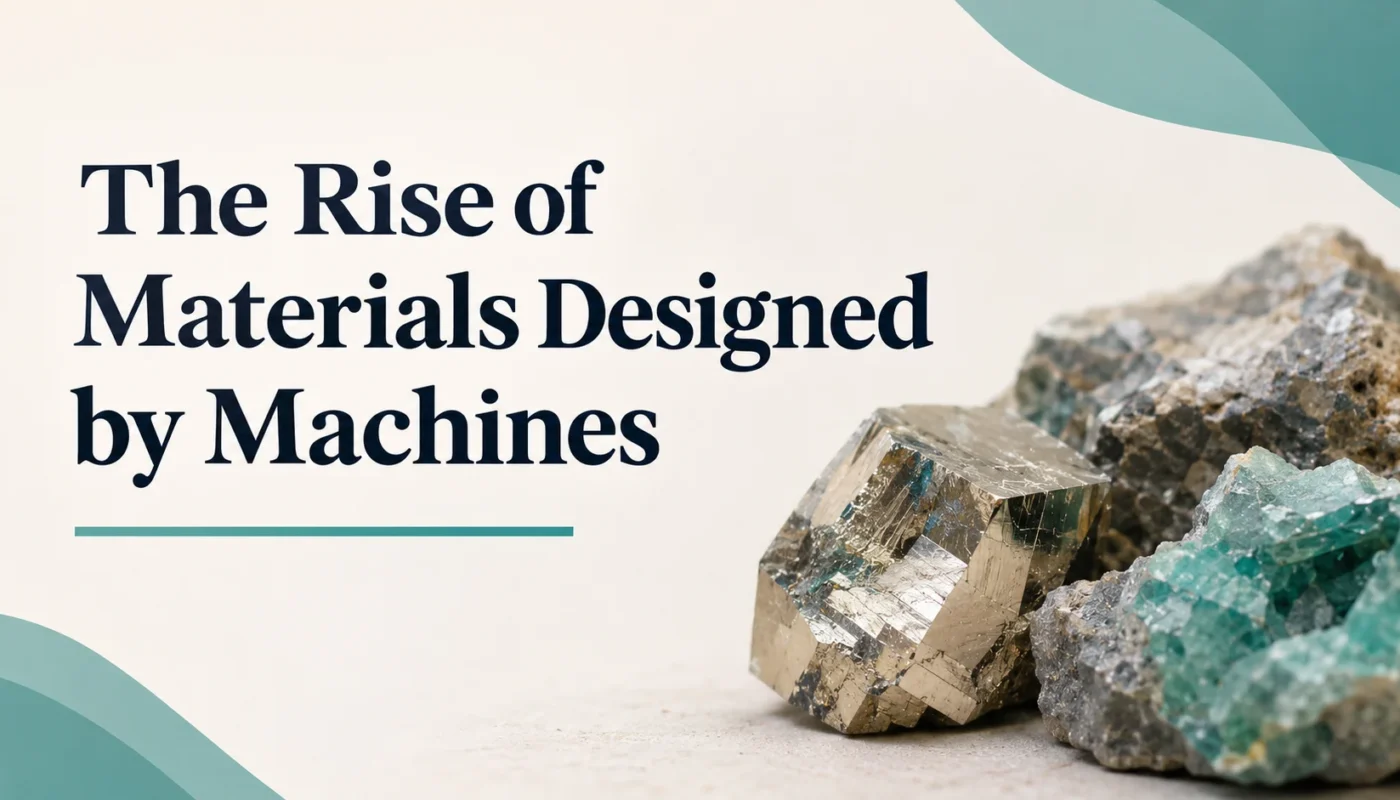
What if scientists could describe the properties they need and let artificial intelligence help design the material itself?
For decades, materials discovery has relied on experimentation, computational simulations, and repeated adjustments to chemical compositions. Researchers have developed stronger alloys, efficient semiconductors, advanced battery components, and materials for renewable energy through this process. However, the number of possible atomic combinations is enormous, making conventional discovery slow and computationally demanding.
Artificial intelligence is beginning to change this approach. Machine-learning models can examine large chemical spaces, predict material properties, and generate structures that researchers might not have considered. Instead of searching only among existing materials, scientists are increasingly exploring whether entirely new structures can be designed around specific technological requirements.
The search space is bigger than the laboratory
A material’s behaviour depends on more than its chemical composition. The arrangement of its atoms, crystal structure, and interactions between neighbouring elements can determine whether it conducts electricity, withstands heat, or exhibits magnetic properties. Even materials containing the same elements can behave differently when their atomic arrangements change.
Traditional computational methods, particularly Density Functional Theory (DFT), help researchers calculate the energetic and electronic properties of candidate structures. However, performing these calculations across millions of possibilities requires substantial computational resources. This limits how much of the potential materials space can be explored.
Machine learning offers a way to narrow that search. Models trained on existing computational and experimental datasets can learn relationships between atomic structures and their properties, allowing them to estimate the behaviour of unfamiliar candidates much faster. Graph neural networks are particularly useful because they represent atoms as interconnected nodes, learning how their local environments influence the properties of the complete structure.
The objective is not to replace physical simulations but to make them more selective. AI can identify promising candidates first, allowing researchers to concentrate expensive calculations and laboratory experiments where they are most valuable.
From predicting materials to generating them
Early applications of machine learning in materials science focused primarily on prediction. Researchers supplied a chemical composition or crystal structure, and models estimated properties such as formation energy, electronic band gap, or mechanical strength. This is known as forward prediction: determining what a material might do based on its existing structure.
Inverse materials design approaches the problem differently. Suppose researchers need a semiconductor with a particular band gap or a battery material with improved ionic conductivity. Instead of starting with known compounds and testing them individually, they can use generative models to propose structures that may satisfy those requirements.
Diffusion models have emerged as an important approach to this process. Originally developed for generating images, these models learn patterns in existing data and gradually transform noisy representations into structured outputs. In materials science, they can be adapted to generate atomic arrangements and crystal structures, sometimes guided by desired physical or chemical properties.
However, generating a theoretically plausible structure does not guarantee that it exists in a stable form or can be manufactured. This distinction makes physical validation essential. The real advancement is the possibility of moving from selecting known candidates towards generating new ones under scientifically meaningful constraints.
Materials discovery is shifting from a search problem into a design problem: instead of asking which known material fits a requirement, researchers can begin with the requirement itself and explore what material might satisfy it.
Predicted Properties
New Candidate Structures
Figure 1. Forward prediction estimates the properties of existing structures, while inverse design generates candidate structures based on desired material properties.
GNoME and the expansion of known materials
One of the most significant demonstrations of large-scale AI-assisted materials discovery came from Google DeepMind’s Graph Networks for Materials Exploration, better known as GNoME. Published in Nature in 2023, the research used graph neural networks to identify potentially stable inorganic crystal structures through two complementary approaches: exploring variations of existing structures and investigating new chemical compositions.
The results significantly expanded the computational landscape of known materials. GNoME identified approximately 2.2 million candidate crystal structures, including 381,000 predicted to be stable on the updated thermodynamic convex hull. Researchers also reported that 736 of these structures had already been independently experimentally realized. [1]
2.2M · Total candidates
Figure 2. GNoME expanded computational materials discovery by identifying approximately 2.2 million candidate structures, including 381,000 predicted to be stable on the thermodynamic convex hull.
These figures require an important distinction: computationally predicted materials are not automatically laboratory discoveries. A structure may appear stable in theoretical calculations but remain difficult to synthesize because of its reaction conditions, competing phases, or other physical constraints.
Nevertheless, GNoME demonstrated that machine-learning systems could explore chemical spaces at a scale that would be difficult to achieve through conventional screening alone. It also established an important relationship between AI predictions and established scientific methods: neural networks identify promising candidates, while quantum-mechanical calculations provide further evaluation.
MatterGen and the move towards property-driven design
While GNoME demonstrated how AI could expand the search for stable materials, Microsoft’s MatterGen took the next step by generating materials according to desired properties. Published in Nature in 2025, MatterGen is a diffusion-based generative model designed specifically for inorganic materials. Researchers can guide its generation using conditions such as chemical composition, symmetry, mechanical properties, and electronic or magnetic characteristics. [2]
Consider a researcher looking for a material with a particular mechanical property. Instead of repeatedly modifying existing compounds, they can provide the desired property as a condition and allow the model to generate candidate structures. This makes materials discovery more closely resemble an engineering design process, where the requirements are established before the solution is developed.
↓
Figure 3. MatterGen uses desired material properties to guide generative diffusion towards new inorganic crystal structures, which must subsequently undergo computational and experimental validation.
MatterGen also demonstrated an experimental proof of concept. The researchers synthesized a material generated by the model and measured a property value within 20% of the target. [2] Although this does not establish that every generated structure can be manufactured, it provides an important connection between computational generation and physical experimentation.
The difference between GNoME and MatterGen is particularly significant. One demonstrated the expansion of computational materials discovery, while the other moved towards generating candidates around specific design requirements. Together, they illustrate how AI is changing not only the scale of discovery but also the way researchers approach it.
Figure 4. A simplified multi-objective optimization framework for identifying materials that balance desired properties with practical design constraints.
Designing for real-world applications
The potential of AI-designed materials extends across industries where even small improvements in material properties can have significant consequences.
Energy storage is one of the most promising areas. Batteries require materials that balance ionic conductivity, electrochemical stability, energy density, and durability. AI-assisted discovery could help researchers explore new electrode compositions and solid electrolytes, although long-term cycling and manufacturing tests remain necessary.
Semiconductors and electronics offer another opportunity. Their performance depends heavily on electronic structure, band gaps, and thermal properties. Machine-learning models can help identify promising candidates for advanced computing, optoelectronics, and power electronics.
Catalysis and carbon capture also present important possibilities. Researchers could use AI to investigate materials that improve chemical reaction efficiency or selectively capture carbon dioxide. In these applications, surface interactions, adsorption properties, and chemical stability are critical to determining whether a candidate will work outside computational simulations.
The common challenge across these industries is not simply finding a material with an impressive predicted property. It is identifying one that performs reliably under actual operating conditions while remaining economically and environmentally practical.
| Application | Target Material Properties | Potential Impact |
|---|---|---|
| Energy Storage | Ionic conductivity, electrochemical stability, energy density | Improved battery components and solid electrolytes |
| Semiconductors | Band gap, electronic structure, thermal properties | Advanced computing and optoelectronic devices |
| Catalysis | Surface activity, selectivity, chemical stability | More efficient industrial chemical reactions |
| Carbon Capture | Adsorption capacity, selectivity, regeneration stability | Improved carbon dioxide separation and capture |
Figure 6. Potential applications of AI-assisted materials discovery, highlighting the properties that influence their suitability for different technologies.
When AI-designed materials meet the laboratory
There is still a considerable gap between generating a promising structure and producing a usable material. Researchers must identify suitable starting chemicals, determine synthesis conditions, and verify whether the resulting material has the predicted properties. Defects, impurities, and variations in experimental conditions can all affect the outcome.
An important development addressing this challenge is the emergence of autonomous laboratories. These facilities combine computational models, robotic equipment, and experimental feedback to make materials research more efficient.
A notable example is the A-Lab, introduced in a 2023 Nature paper. The laboratory combines machine learning, computational materials data, scientific literature, and robotic synthesis equipment to plan and perform experiments. During 17 days of operation, researchers reported realizing 36 compounds from 57 targets. [3]
What makes this development particularly interesting is the feedback mechanism. Experimental results can influence subsequent decisions, allowing the system to adjust synthesis conditions or explore alternative approaches. Even unsuccessful experiments provide information that can guide future attempts.
A predicted structure becomes scientifically meaningful only when it survives contact with the laboratory. The strongest discovery systems will therefore connect computational predictions with experimental evidence in a continuous feedback loop.
Figure 5. An autonomous materials laboratory connects AI predictions, robotic synthesis and experimental characterization through a feedback-driven discovery process.
This approach connects computational discovery with physical experimentation rather than treating them as separate stages. Recent research increasingly identifies such integrated workflows as an important direction for AI-driven materials science. [4, 6]
The limitations that remain
Despite these advances, AI-designed materials face several scientific and practical challenges. One major limitation is data quality. Materials databases contain missing measurements, inconsistent experimental conditions, and uneven coverage of different chemical structures. Consequently, a model that performs well on familiar materials may struggle when predicting genuinely unfamiliar candidates. [5]
Another challenge is physical stability and synthesizability. A structure may appear promising according to computational predictions but remain unstable under actual operating conditions or require manufacturing processes that are difficult to reproduce. Thermodynamic stability alone cannot establish whether a material will be commercially useful.
There are also economic and environmental considerations. A material that performs exceptionally well but depends on scarce elements, expensive processing, or environmentally harmful components may not be suitable for large-scale deployment. Researchers must therefore consider availability, cost, toxicity, recyclability, and manufacturing compatibility alongside predicted performance.
These limitations reinforce an important point: AI can accelerate the search for materials, but it cannot independently establish their practical value. Reliable discovery requires a combination of computational predictions, physical simulations, experimental evidence, and scientific judgment.
The future of materials discovery is becoming a design process
The significance of AI in materials science goes beyond faster calculations or larger databases. It represents a change in how researchers approach the search for useful matter. Instead of limiting exploration to combinations that can be manually imagined and tested, scientists can increasingly use computational models to generate and evaluate possibilities on a much larger scale.
GNoME demonstrated how machine learning could expand the search for stable crystal structures. MatterGen showed how generative models could propose materials based on desired properties, while A-Lab demonstrated how computational predictions could be connected to automated laboratory experiments. Together, these developments point towards a more integrated approach to scientific discovery.
The next challenge is to consistently transform promising predictions into materials that can be synthesized, manufactured, and used reliably. This will require better datasets, more physically informed models, improved experimental automation, and closer collaboration between computational scientists and materials researchers.
Ultimately, the future of materials science may not depend on machines independently inventing every new substance. It may depend on systems in which AI explores possibilities, simulations evaluate their physical plausibility, and scientists determine which discoveries can survive real-world testing.
The shift is no longer just about discovering what materials exist. It is about learning how to design what matter could become.
References
[1] Scaling deep learning for materials discovery.
Nature, 2023.
https://www.nature.com/articles/s41586-023-06735-9
[2] A generative model for inorganic materials design.
Nature, 2025.
https://www.nature.com/articles/s41586-025-08628-5
[3] An autonomous laboratory for the accelerated synthesis of inorganic materials.
Nature, 2023.
https://www.nature.com/articles/s41586-023-06734-w
[4] Artificial intelligence-driven approaches for materials design and discovery.
Nature Materials, 2026.
https://www.nature.com/articles/s41563-025-02403-7
[5] Machine learning in materials research: Developments over the last decade and challenges for the future.
Current Opinion in Solid State and Materials Science, 2024.
https://doi.org/10.1016/j.cossms.2024.101189
[6] AI for Accelerated Materials Discovery: From Generative Design to Autonomous Realization.
Chemical Reviews, 2026.
https://doi.org/10.1021/acs.chemrev.6c00154