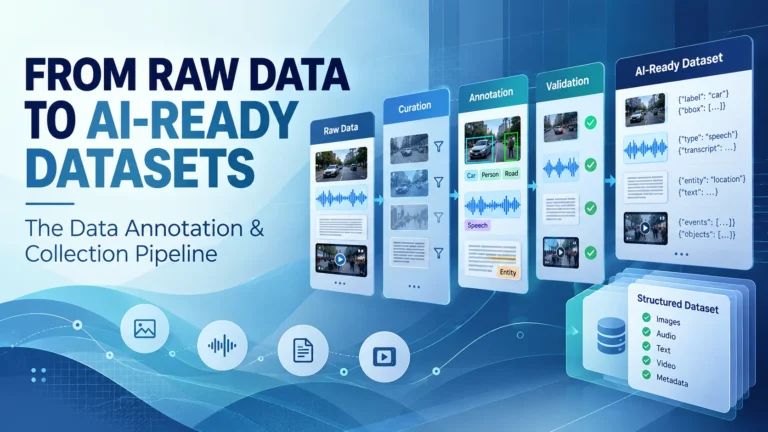

There is an old saying that “jack of all trades, master of none, yet oftentimes better than a master of one”. In artificial intelligence, this saying is starting to break.
Across coding, medicine and law, smaller, specialized models trained on the right data are now beating the biggest general-purpose systems at their own tasks, a quiet reversal in how companies actually deploy AI.
The assumption was simple: the bigger and more expensive the model, the better the result. That is now being tested in a growing number of real cases and it is failing more often than expected
Understanding the Building blocks of these models
Every AI model, at its core, is built from billions of numerical values called weights or parameters, the model’s accumulated learning from everything it has read. The more refined these weights are for a given purpose, the better the model performs at that purpose.
Some companies keep these weights locked away, letting people interact with the model only through a chat window or an API. GPT-5 and Claude work this way. Some release the weights openly, so anyone can download the model, run it on their own hardware, and keep training it further on their own data. This second kind is called an open-weight model, and it includes families such as Meta’s Llama, Alibaba’s Qwen, China’s Deep Seek and Google’s Gemma. Continuing to train one of these on specific data is called fine-tuning, and it is what allows a general-purpose model to become a narrow specialist.
Alongside open-weight models sits the term frontier model, not a brand, but a category referring to whichever models currently represent the most advanced capability available, such as GPT-5, Claude Opus, and Gemini Pro. Built at enormous cost and scale, they are trained to handle almost anything, which gives them breadth, while fine-tuned models trade that breadth for depth — knowing one thing extremely well. For most narrow, repeatable business tasks, knowing one thing well tends to matter more.
| Model type | Best at | Main strength |
| Frontier | Many different tasks | Breadth |
| Fine-tuned | One defined task | Depth |
| Hybrid | Mixed workloads | Flexibility + efficiency |
How Fine-Tuning Works
Fine-tuning takes an existing open-weight model and trains it further on real examples from one specific job. A support message and its ideal reply, a broken piece of code and its fix. The quality of the examples matters enormously. A model trained on messy data simply learns the mess. Curated datasets, not just large ones, tend to produce the best results.
Techniques such as LoRA (Low-Rank Adaptation) [1] make this affordable by updating only a small part of the model rather than retraining the whole thing. Instead of changing every value in a model’s original weight matrix, LoRA freezes it and adds a much smaller correction on top, expressed as:
W = W₀ + ΔW = W₀ + BA
where B and A are small matrices, whose size is controlled by a single number, the ‘rank.’
The process is also remarkably lean, a modest graphics card, a few thousand well-chosen examples, and a small team are often enough. And because the data never leaves an organization’s own servers, sensitive records in healthcare, finance, or law can stay entirely in-house.
Task-specific example
↓
Model makes a prediction
↓
Compare with the correct answer
↓
Measure the error
↓
Adjust the model’s weights
↓
Repeat with many examples
↓
Test on new examples
↓
Specialised model
The Evidence
The same pattern shows up across very different fields. In clinical documentation, a fine-tuned Gemma 3 model, initially clearly weaker than Claude Sonnet 4, ended up outperforming it by a wide margin after training on real scribe-note data, while running faster and cheaper. [2] In tool-calling, the skill an AI agent needs to correctly operate software, a fine-tuned model many times smaller than GPT-4o beat it outright on a recognized benchmark. [3]
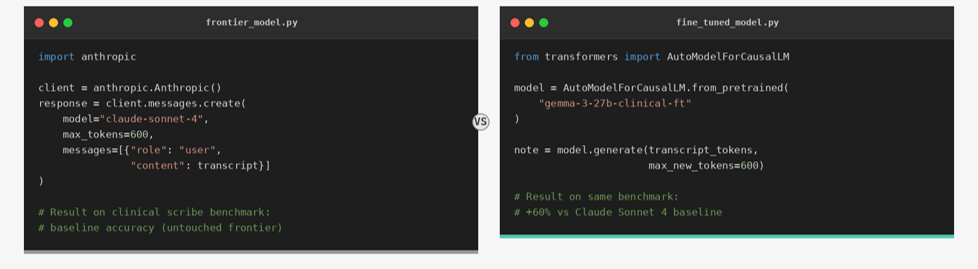
Illustrative code. Figures (−35%→+60% vs. Sonnet 4) from Parsed/Together AI, 2026. [2]
In programming, a model fine-tuned on real Rust code outperformed both GPT-5-Codex and Claude Sonnet 4.5 on Rust-specific tasks, [4] a result which deduced, rarer a domain is in general training data, the more, a focused, well-curated dataset can outperform even the newest frontier models.
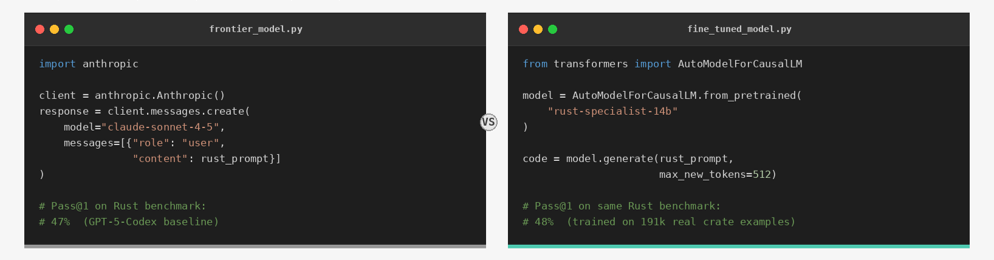
Illustrative code. Figures (48% vs. 47%) from Fortytwo Network model card, 2026. [4]
Each case tells the same story: a smaller, purpose-built model, trained on the right data, moving ahead of the giant generalist on the one job it was actually built for, often at a fraction of the running cost, and with none of the reliance on an outside provider.
| Example | Specialist | Key figure | What it tells us |
| Clinical scribe | Gemma 3 27B | −35% → +60% vs Sonnet 4 | Task-specific training can reverse the ranking. |
| Tool calling | OPT-350M | 77.55% ToolBench | A tiny model can excel at one narrow skill. |
| Rust coding | Rust specialist 14B | 48% vs 47% GPT-5 Codex | Deep domain data can close a size gap. |
How specialised, fine-tuned models have matched or outperformed larger frontier models on specific real-world tasks.
Where Frontier Models Still Matter
None of this makes frontier models obsolete, for open-ended, ambiguous problems, their breadth still wins. Fine-tuning carries its own risk too: a model trained too narrowly can grow brittle outside its lane, which is why careful evaluation matters as much as the training itself.
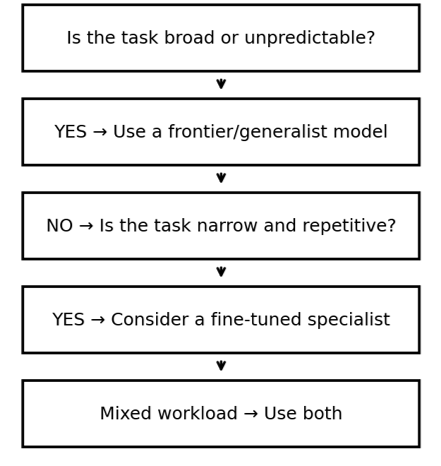
when to choose the generalist model
This is largely why most companies today use both together, called a hybrid approach, a frontier model handling the hard, unpredictable decisions, and fine-tuned specialists handling the repeatable, high-volume work underneath it, faster and at a fraction of the cost.
That old saying about generalists still holds some truth, but in AI it now comes with an asterisk, the master of one no longer needs to be bigger to win, only trained well.
General intelligence builds the door. Specialized training is what actually walks through it.
References
[1] Hu, E. J., Shen, Y., Wallis, P., et al. “LoRA: Low-Rank Adaptation of Large Language Models.” arXiv:2106.09685 (2021).
https://arxiv.org/abs/2106.09685
[2] “Fine-Tuning Small Open-Source LLMs to Outperform Large Closed-Source Models by 60% on Specialized Tasks.” Together AI / Parsed research blog, 2026.
https://www.together.ai/blog/fine-tune-small-open-source-llms-outperform-closed-models
[3] “Small Language Models for Efficient Agentic Tool Calling: Outperforming Large Models with Targeted Fine-tuning.” arXiv:2512.15943 (2025).
https://arxiv.org/pdf/2512.15943
[4] Fortytwo-Network. “Strand-Rust-Coder-14B-v1” model card. Hugging Face, 2026.
https://huggingface.co/Fortytwo-Network/Strand-Rust-Coder-14B-v1